
Scope of this technical record
Use this hub when a Danfoss VLT FC-family case needs to route output, input, thermal or braking evidence before a drive-side repair decision.
VLT service work involves hazardous mains and DC-link voltage. Follow lockout, discharge and qualified measurement procedures before opening the drive or touching motor cables.
Danfoss VLT output fault cluster route
Alarm 14 and Alarm 16 are routed through external output evidence before drive-side module or sensor decisions.
Danfoss VLT output fault cluster image
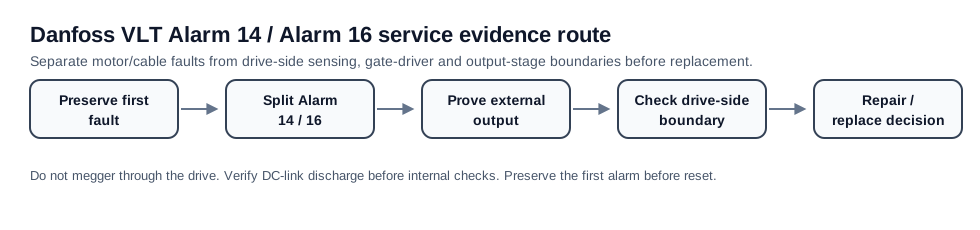
Split the alarm by physical path
Danfoss VLT alarms become useful when they are tied to a physical path. Alarm 14 and Alarm 16 belong first to the output path. Alarm 4 belongs first to the input supply path. Alarm 29 belongs first to cooling and thermal evidence. Deceleration overvoltage belongs first to energy management and braking evidence.
A repair request should not jump from an alarm label to an output module or control board. Record the first trip timing, whether the motor/cable has been isolated, whether input voltage was measured at the drive terminals, whether cooling evidence matches the alarm, and whether braking energy is being absorbed correctly.
Danfoss evidence packages by route
The output-fault route needs motor, cable, insulation, terminal and current-sensing evidence. The input route needs L1/L2/L3 measurements, fuses, contactor and rectifier/DC-link context. The thermal route needs fan, filter, heatsink, cabinet ambient and load-current evidence. The braking route needs line voltage, deceleration ramp, load inertia, resistor and chopper evidence.
The hub is designed so a technician can enter by alarm number but leave with an evidence package that supports field correction, drive repair, fan or resistor work, used-unit replacement or a newer-drive conversion.
VLT first-route selector
| Alarm or symptom | First evidence route | Do not start with |
|---|---|---|
| Alarm 14 | Motor/cable to ground, output terminals and current-sensing boundary | Current sensor replacement without isolation |
| Alarm 16 | Phase-to-phase short, output wiring and IGBT/gate-drive boundary | Repeated start command |
| Alarm 4 | Input phases, fuses, contactor and DC-link evidence | Control board |
| Alarm 29 | Fan, airflow, heatsink, cabinet ambient and temperature feedback | Bypassing thermal protection |
| Overvoltage on decel | Regeneration, ramp, resistor, chopper and DC-link feedback | Only increasing ramp without checking duty |
Field record checklist
- Exact FC model and frame
- Alarm order and timing
- Motor/cable isolation result
- Input voltage at drive terminals
- Fan/heatsink/cabinet condition
- Brake resistor/chopper evidence
Technical basis and reference documents
This is an independent editorial technical reference. Original manufacturer documentation remains controlling for installation, repair and commissioning decisions.
Lists alarm meanings and first troubleshooting boundaries for alarms 4, 14, 16, 29 and DC-link overvoltage.
Provides field-versus-drive separation guidance for Alarm 14 earth fault cases.
Model records
Fault records
The VLT trips or warns on DC-link overvoltage when the machine slows, stops a high-inertia load, lowers a vertical load, or returns energy from the motor into the drive.
The Danfoss VLT reports alarm 14, trips on start or trips when the motor cable is connected.
The VLT reports alarm 16 or trips instantly when the inverter output is enabled.
The VLT reports mains phase loss, trips at power-up, or loses ready state when plant load changes.
The VLT trips on alarm 29 during load, in high ambient temperature, or after cooling airflow has degraded.
The VLT trips on overvoltage when the machine slows down, stops a high-inertia load or lowers a regenerative load.
Board and assembly records
Documents whether regenerated energy is being dissipated through a correctly installed brake path or whether the case belongs to ramp tuning, resistor sizing, thermal protection, brake transistor or DC-link sensing repair.
Captures alarm 14 and alarm 16 evidence around motor cable, earth leakage, output terminals, IGBT module, gate driver and current detection.
Supports alarm 29 diagnosis by collecting fan, heatsink, cabinet airflow, load current and ambient evidence before board replacement.
Circuit and diagnostic records
Routes Alarm 4, undervoltage and deceleration overvoltage through the same energy path: L1/L2/L3 input, fuses, contactor, rectifier, DC-link capacitors, brake chopper, braking resistor and DC-link voltage feedback.
Routes a Danfoss VLT deceleration-overvoltage case through regenerated load energy, ramp settings, DC-link rise, brake-chopper availability, resistor value, resistor thermal contact, wiring and hardware repair boundary.
Routes alarm 4 and deceleration overvoltage through line phases, fuses, contactor, rectifier, DC-link ripple, high line voltage and braking energy paths.
Routes alarm 14 and alarm 16 through output insulation, terminal contamination, motor cable damage, IGBT module, gate driver and current-feedback path.
Routes alarm 29 through cooling fans, heatsink contamination, airflow, cabinet ventilation, ambient temperature, load current and temperature feedback.
The VLT reports Alarm 7 / DC-link overvoltage or a DC-voltage warning when the machine decelerates, performs quick stop, lowers a load or stops a high-inertia fan, pump or conveyor.
Danfoss VLT reports alarm 14 earth fault or alarm 16 short circuit.
Danfoss VLT reports alarm 4 or shows input phase instability.
Danfoss VLT reports alarm 29 during operation or immediately after power-up.
Danfoss VLT trips on overvoltage during deceleration, stop or load lowering.
Turn this record into a qualified service request
A repair decision is much more reliable when the request includes the exact identity of the drive, the first fault evidence and the machine condition when the symptom appeared.
- Complete drive type code / MLFB or nameplate model
- Fault code, fault value and first event before reset
- When the event appears: power-up, enable, ramp, run, decel or stop
- Motor/cable connected or isolated during the symptom
- Visible board, option-card, module and connector identifiers
- Previous repair history, replacement parts and repeat-failure pattern