
Scope of this technical record
Danfoss VLT brake chopper and braking resistor path for Alarm 7 / deceleration overvoltage cases where regenerated energy, resistor capacity, chopper option and thermal protection must be proven before repair or replacement advice.
Brake resistor terminals, chopper circuits and DC-link nodes can carry hazardous voltage and heat. Do not inspect or measure without qualified isolation and a verified discharged DC link.
Danfoss brake chopper / resistor route
The path proves whether the installed brake hardware can absorb the machine energy.
Danfoss VLT brake chopper and resistor path
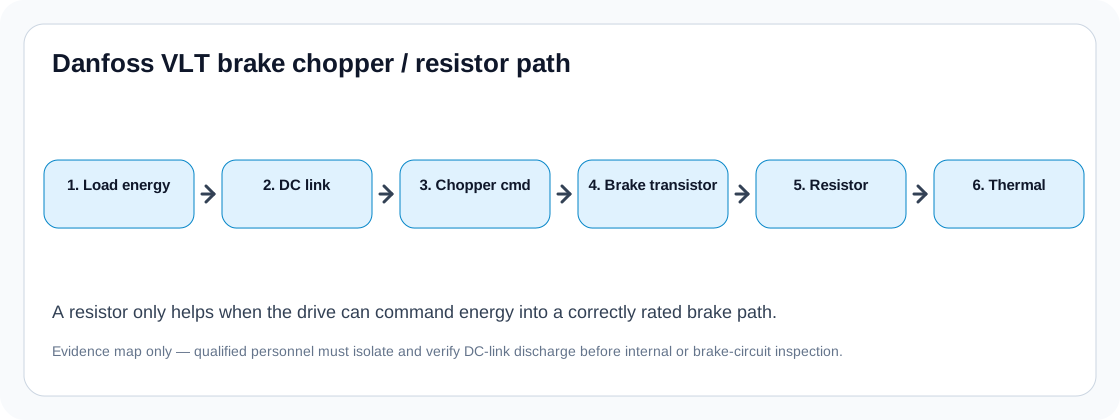
The brake path is a system, not a single part
A brake resistor only helps if the drive can command energy into it and if the resistor can absorb the duty cycle safely. The path includes load inertia, deceleration profile, DC-link voltage, brake-chopper option, brake transistor, resistor value, resistor thermal contact and cabinet heat. Missing any one part can leave the overvoltage problem unchanged.
Danfoss documentation describes the brake resistor as absorbing brake power generated in regenerative braking. That is the key service concept: the resistor is not a cure for every DC-link alarm; it is an energy destination for a specific operating condition.
Brake-path evidence checklist
A useful brake-path record should prove the installed hardware and the required duty. The same resistor that works for occasional stops may overheat in repeated short-cycle service. A cabinet-mounted resistor may reduce DC-link voltage while raising cabinet temperature. A drive without a brake option may need an external solution rather than a resistor wired to unused terminals.
Brake chopper / resistor decision table
| Evidence | Service meaning | Action boundary |
|---|---|---|
| No brake option present | Drive may not be able to use a resistor directly | Check option / external braking solution |
| Wrong resistor value | Chopper may fault, overheat or fail to absorb energy | Match resistor to frame and duty |
| Thermal contact open | Resistor overheating or wiring issue | Fix thermal route before reset |
| Brake command absent | Control/chopper path suspect | Do not blame resistor alone |
| Cabinet heat excessive | Resistor placement/duty problem | Consider external mounting or duty redesign |
When the brake path becomes a board case
A board-level brake chopper or DC-link feedback case is credible when the resistor value, wiring, thermal contact, input line and load/ramp evidence are all known. If those details are missing, the safest output is evidence collection. If they are present and the brake path still does not act, the next boundary is chopper command, brake transistor, drive option compatibility and DC-link voltage feedback.
Field record checklist
- Brake option and frame information
- Brake resistor label and measured ohms
- Thermal contact state and wiring
- Cabinet or external resistor placement
- Stop frequency and inertia/duty description
- Evidence of brake command or chopper fault where available
Technical basis and reference documents
This is an independent editorial technical reference. Original manufacturer documentation remains controlling for installation, repair and commissioning decisions.
Defines Alarm 7 / DC-link overvoltage checks around input phase-to-phase voltage and regenerative voltage from the motor end.
Describes brake-resistor function as absorbing brake power generated in regenerative braking and supports the brake-energy route used here.
Explains why external brake-resistor placement can improve heat handling, duty-cycle selection and braking-energy dissipation.
Turn this record into a qualified service request
A repair decision is much more reliable when the request includes the exact identity of the drive, the first fault evidence and the machine condition when the symptom appeared.
- Complete drive type code / MLFB or nameplate model
- Fault code, fault value and first event before reset
- When the event appears: power-up, enable, ramp, run, decel or stop
- Motor/cable connected or isolated during the symptom
- Visible board, option-card, module and connector identifiers
- Previous repair history, replacement parts and repeat-failure pattern