
Scope of this technical record
A PowerFlex service platform for F12/F13 output faults, F5/F4 DC-bus faults and F81-F86 DPI/HIM port-loss cases where the repair route depends on event timing and field evidence.
Do not repeatedly reset into output, ground or DC-bus faults. Verify machine state and stored-energy discharge before internal or output-path inspection.
PowerFlex service platform route
The platform routes PowerFlex cases into output, DC-bus or DPI evidence before drive replacement.
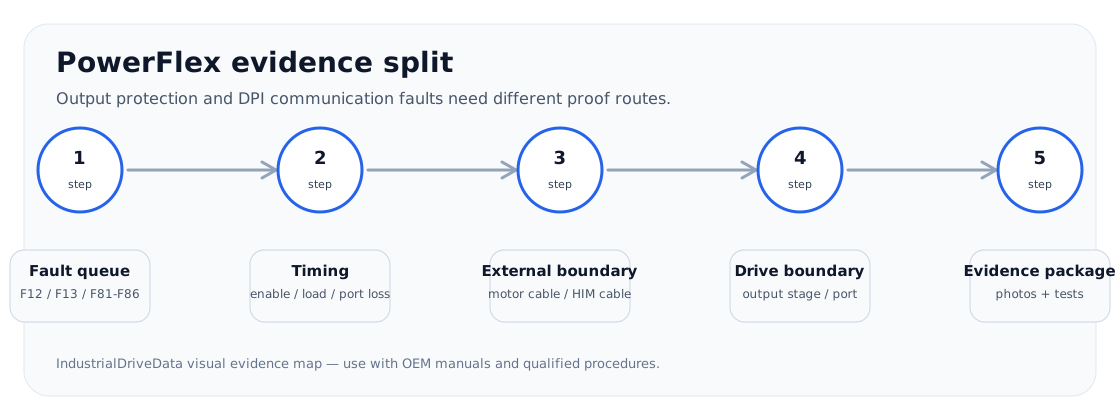
PowerFlex platform evidence image
Platform scope
The PowerFlex platform pages are not model catalog pages. They are written for field and repair decisions on installed PowerFlex 520/750-family machines where the technician already has a fault code and a production symptom. The practical question is whether the drive is seeing a field problem, an energy problem, or an internal electronics boundary.
F12/F13 are grouped because overcurrent and ground-fault evidence often overlap in the motor/output path. F5/F4 are grouped because both belong to the input/DC-link/braking energy path. F81-F86 are kept separate because the HIM/DPI path can affect control source and network status even when the power stage is healthy.
Decision matrix for the first hour
The first hour should preserve evidence, not clear it. Record the fault queue, the moment in the machine cycle, whether a brake or mechanical load was involved, whether the drive had a connected motor, and whether any communication device moved or lost power.
Fast triage without destructive retesting
| Fault family | Do first | Escalate only after |
|---|---|---|
| F12 / F13 | Classify trip timing and inspect motor/cable/load | External output path is proven or fault persists with a qualified isolated test |
| F5 / F4 | Measure input and correlate DC-bus behaviour with stop/decel or supply sag | Brake path or input path evidence points inward |
| F81-F86 | Identify port/device and test cable/HIM/adapter behaviour | Fault follows port or remains after device/cable/noise evidence is resolved |
Repair request structure
A PowerFlex repair request is stronger when it asks a bounded question: output stage and current-sense evaluation, DC-bus/brake-path evaluation, or DPI/HIM communication evaluation. Mixed evidence should be preserved rather than forced into one suspected part.
The platform page links to the fault, circuit, workflow and evidence-record pages so that a technician can move from a fault number to the correct evidence package.
Field record checklist
- Fault family
- Machine-cycle timing
- External path evidence
- Internal escalation boundary
- Repair request type
Technical basis and reference documents
This is an independent editorial technical reference. Original manufacturer documentation remains controlling for installation, repair and commissioning decisions.
OEM manual used for PowerFlex safety, terminal and troubleshooting context.
Model records
Fault records
PowerFlex drive reports F12 / HW Overcurrent, often at start, acceleration or during a sudden load event.
PowerFlex reports F13 ground fault, sometimes intermittently and sometimes followed by a hardware-overcurrent trip.
PowerFlex reports F5 during deceleration, fast stop, lowering load or high line condition.
PowerFlex trips on F4 at power-up, when plant loads start, or after a supply dip.
PowerFlex 750-class drive trips on a DPI port-loss fault or loses communication with HIM, TCOMM, adapter or peripheral device.
Board and assembly records
Captures F12 and F13 evidence around the motor path, output module, current sensors, gate-driver boundary and previous repair history.
Captures port-loss fault number, connected DPI/HIM device, cable routing, adapter status and electrical-noise context.
Circuit and diagnostic records
Routes F12 and F13 evidence through output bridge, current sensing, motor cable, motor insulation, grounding/shielding and mechanical load conditions.
Routes F4 and F5 evidence through input phases, fuses/contactors, precharge, DC-link capacitors, brake chopper/resistor, load inertia and line voltage.
Routes F81-F86 port-loss evidence through HIM, DPI cable, TCOMM/adapter, port number, electrical noise, grounding and control-board communication context.
PowerFlex drive reports F12 hardware overcurrent, F13 ground fault, or both around the same start/run event.
PowerFlex trips on F5 DC bus overvoltage or F4 undervoltage during power-up, line sag, acceleration or deceleration.
PowerFlex reports DPI port loss, HIM loss or communication loss to a connected port device.
Turn this record into a qualified service request
A repair decision is much more reliable when the request includes the exact identity of the drive, the first fault evidence and the machine condition when the symptom appeared.
- Complete drive type code / MLFB or nameplate model
- Fault code, fault value and first event before reset
- When the event appears: power-up, enable, ramp, run, decel or stop
- Motor/cable connected or isolated during the symptom
- Visible board, option-card, module and connector identifiers
- Previous repair history, replacement parts and repeat-failure pattern