
Scope of this technical record
Family-level PowerFlex record for installed 520/750-class drives where exact type, frame and connected HIM/DPI devices determine whether the right repair path is output, DC bus or communication.
Do not treat a family page as a substitute for the exact manual for the installed frame and voltage class. Stored energy and driven-machine hazards remain model-specific.
PowerFlex model identity route
Identity evidence decides whether a PowerFlex case belongs to output, DC-bus or communication hardware.
PowerFlex model evidence image
What identity evidence changes
A PowerFlex type code and frame decide the service boundary: available display values, port devices, brake options, dynamic braking configuration, cooling layout and power-stage construction. A field report that only says “PowerFlex 525 F12” or “PowerFlex 755 F13” is useful, but it is not complete enough for board-level repair.
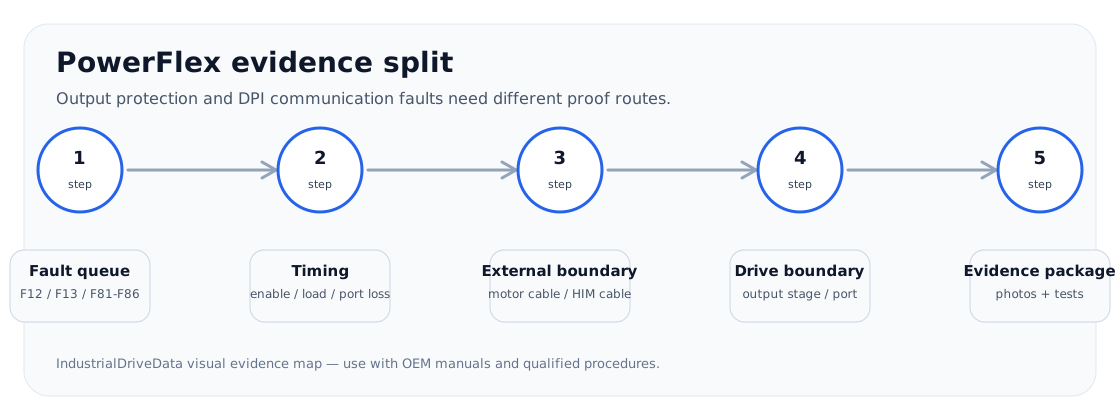
The model-family page tells the technician what to capture before the drive is removed: full nameplate, frame/voltage class, connected motor and cable length, brake resistor or line reactor presence, HIM/DPI hardware and the fault queue.
Identity-to-route table
The same fault label has different implications when the drive is used on a fan, conveyor, hoist, pump or network-controlled production cell.
PowerFlex identity evidence
| Evidence | Why it matters | Routes affected |
|---|---|---|
| Voltage class and frame | Defines DC-bus limits, power-stage scale and service parts | F4/F5, F12/F13 |
| Dynamic brake equipment | Explains deceleration overvoltage and resistor/chopper suspicion | F5, brake path |
| Motor cable and output accessories | Can cause overcurrent, ground fault or reflected-wave stress | F12/F13 |
| HIM/DPI or adapter hardware | Defines which device or port can be lost | F81-F86 |
| Fault queue order | Shows whether output, ground, bus or port fault happened first | All PowerFlex workflows |
Model-page close-out
A good model record ends with an action: collect missing identity evidence, follow an output/DC-bus/DPI workflow, or prepare a repair request with board and field evidence. It should not end with a generic statement that the drive is obsolete or must be replaced.
Field record checklist
- Full type code
- Voltage class and frame
- Connected options
- Brake/DC-bus equipment
- Fault queue
Technical basis and reference documents
This is an independent editorial technical reference. Original manufacturer documentation remains controlling for installation, repair and commissioning decisions.
OEM quick-start reference for installation and terminal context.
Related technical records
PowerFlex drive reports F12 / HW Overcurrent, often at start, acceleration or during a sudden load event.
PowerFlex reports F13 ground fault, sometimes intermittently and sometimes followed by a hardware-overcurrent trip.
PowerFlex reports F5 during deceleration, fast stop, lowering load or high line condition.
PowerFlex 750-class drive trips on a DPI port-loss fault or loses communication with HIM, TCOMM, adapter or peripheral device.
Routes F12 and F13 evidence through output bridge, current sensing, motor cable, motor insulation, grounding/shielding and mechanical load conditions.
Routes F4 and F5 evidence through input phases, fuses/contactors, precharge, DC-link capacitors, brake chopper/resistor, load inertia and line voltage.
Routes F81-F86 port-loss evidence through HIM, DPI cable, TCOMM/adapter, port number, electrical noise, grounding and control-board communication context.
PowerFlex drive reports F12 hardware overcurrent, F13 ground fault, or both around the same start/run event.
PowerFlex trips on F5 DC bus overvoltage or F4 undervoltage during power-up, line sag, acceleration or deceleration.
PowerFlex reports DPI port loss, HIM loss or communication loss to a connected port device.
Turn this record into a qualified service request
A repair decision is much more reliable when the request includes the exact identity of the drive, the first fault evidence and the machine condition when the symptom appeared.
- Complete drive type code / MLFB or nameplate model
- Fault code, fault value and first event before reset
- When the event appears: power-up, enable, ramp, run, decel or stop
- Motor/cable connected or isolated during the symptom
- Visible board, option-card, module and connector identifiers
- Previous repair history, replacement parts and repeat-failure pattern