
Scope of this technical record
Family-level Unidrive SP/M record for collecting the exact model, option module, feedback and machine-control evidence before interpreting trips.
Model-family information does not replace the exact manual and risk assessment for the installed drive, motor, brake and feedback system.
Unidrive model identity route
Exact option and feedback identity decides the correct Unidrive repair route.
Unidrive model evidence image
Identity evidence for Unidrive
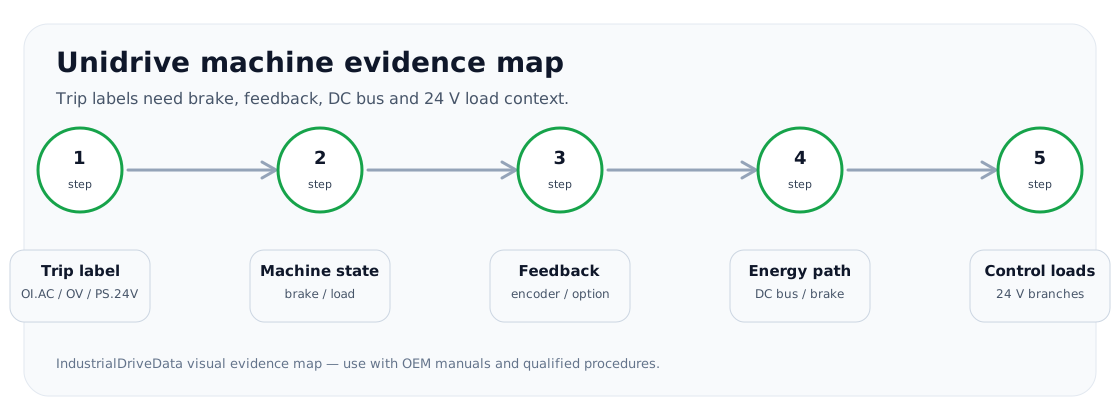
Unidrive support should start with exact model, size, option module arrangement, feedback device, motor/brake data and parameter backup status. Without that context, OI.AC or Over Volts may be wrongly treated as a failed drive instead of a machine-loop issue.
Model evidence table
The model record is the place to capture configuration before removing hardware.
Unidrive identity evidence
| Evidence | Why it matters | Affected route |
|---|---|---|
| SP/M family and size | Defines power-stage and braking/cooling expectations | All routes |
| Option modules | Feedback, fieldbus and I/O behaviour | PS.24V / feedback |
| Encoder type and wiring | Can cause instability or overcurrent in closed loop | OI.AC / feedback |
| Brake/load arrangement | Explains start current and regeneration | OI.AC / Over Volts |
| Parameter backup | Determines repair versus migration difficulty | Modernization boundary |
Field record checklist
- Exact model
- Option modules
- Feedback device
- Brake/load arrangement
- Parameter backup
Technical basis and reference documents
This is an independent editorial technical reference. Original manufacturer documentation remains controlling for installation, repair and commissioning decisions.
User-guide reference for setup and trip-log context.
Related technical records
Unidrive SP or Unidrive M trips on OI.AC during enable, acceleration, load change or unstable closed-loop operation.
Unidrive trips on Over Volts during deceleration, hoist lowering, winder stop or high line condition.
Unidrive reports PS.24V, loses option/module supply, or drops control logic when external loads are connected.
Closed-loop Unidrive application is unstable, trips under load, hunts, overspeeds or reports feedback-related symptoms.
Routes OI.AC and unstable closed-loop behaviour through motor cable, output bridge, current feedback, brake release, encoder feedback, shielding and tuning context.
Routes Over Volts evidence through line voltage, DC bus, load regeneration, deceleration ramp, brake resistor, brake chopper and feedback-induced instability.
Routes PS.24V, thermal feedback and encoder instability through external 24 V loads, option modules, feedback wiring, sensor supply, heatsink feedback and control-board evidence.
Unidrive SP/M reports OI.AC or trips during enable, acceleration, load change or closed-loop instability.
Unidrive reports Over Volts during deceleration, lowering, stop, winder unwind or unstable closed-loop operation.
Unidrive reports PS.24V, thermal feedback symptoms, O.ht/O.ht1 or feedback instability with option modules and external control wiring.
Turn this record into a qualified service request
A repair decision is much more reliable when the request includes the exact identity of the drive, the first fault evidence and the machine condition when the symptom appeared.
- Complete drive type code / MLFB or nameplate model
- Fault code, fault value and first event before reset
- When the event appears: power-up, enable, ramp, run, decel or stop
- Motor/cable connected or isolated during the symptom
- Visible board, option-card, module and connector identifiers
- Previous repair history, replacement parts and repeat-failure pattern