
Scope of this technical record
Routes Unidrive OI.AC through output-current timing, motor/cable, brake/load, feedback direction, encoder supply and output-stage evidence.
Secure the machine before testing. A closed-loop axis, hoist or winder can move unexpectedly if brake or feedback evidence is wrong.
OI.AC overcurrent route
Closed-loop and brake evidence must be checked before a power-stage conclusion.
OI.AC overcurrent machine route image
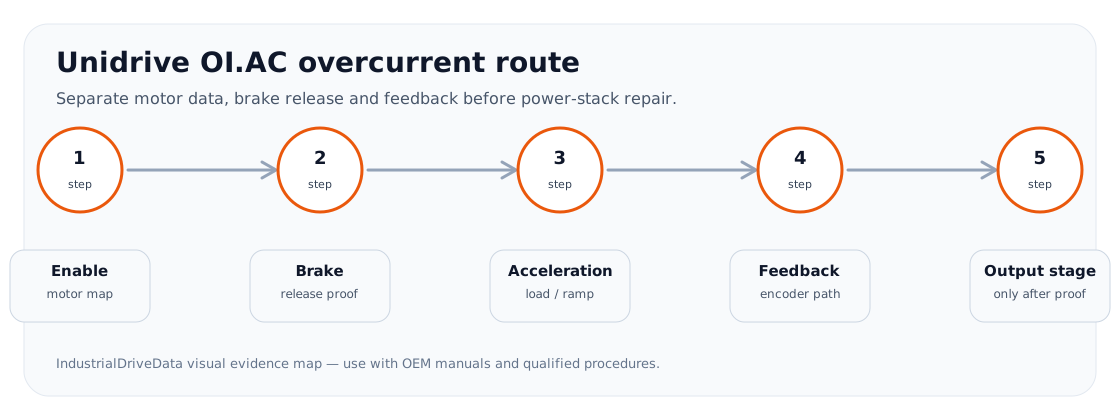
Service decision coverage
OI.AC users need machine evidence: motor map, brake, feedback and load timing. The fault label alone is not enough to justify power-stack repair.
| Observed situation | Decision needed | Evidence that satisfies the case |
|---|---|---|
| Trip at enable | Motor/output or current feedback boundary | Disconnected-output result and motor data |
| Trip at brake release | Brake/load problem | Brake contactor and shaft-release evidence |
| Closed-loop instability | Feedback route | Open-loop comparison and encoder cable evidence |
Why OI.AC is not just a power-stage fault
OI.AC is an AC instantaneous overcurrent label, but Unidrive machines often create overcurrent through machine-loop causes: brake not released, wrong motor data, feedback direction error, encoder noise, shield problems, unstable tuning or a real output short.
The route therefore starts with event timing and control mode. Closed-loop evidence is not optional; it changes whether the drive is responding to impossible feedback or a true load/current condition.
OI.AC split table
Use timing and control mode before internal repair.
Unidrive OI.AC evidence
| Pattern | Likely boundary | Evidence |
|---|---|---|
| Trip on enable | Motor/cable/output or brake held | Output isolation, brake proof |
| Trip on ramp | Load, motor data, current loop | Motor data and acceleration evidence |
| Closed-loop hunting | Feedback direction/noise/tuning | Encoder direction, shield and option module |
| After repair | Driver/current feedback or unresolved field fault | Repair history and staged proof |
| With mechanical jam | Machine boundary | Load and brake evidence |
Repair boundary
Only after motor/cable, brake/load and feedback evidence are credible should an OI.AC case be escalated to output bridge, current feedback or gate-driver electronics.
Field record checklist
- Control mode
- OI.AC timing
- Brake/load state
- Feedback/encoder evidence
- Output path proof
Technical basis and reference documents
This is an independent editorial technical reference. Original manufacturer documentation remains controlling for installation, repair and commissioning decisions.
Public trip-code index for OI.AC and related Unidrive trips.
Trip-description reference for OI.AC overcurrent context.
Diagnostic workflow
Turn this record into a qualified service request
A repair decision is much more reliable when the request includes the exact identity of the drive, the first fault evidence and the machine condition when the symptom appeared.
- Complete drive type code / MLFB or nameplate model
- Fault code, fault value and first event before reset
- When the event appears: power-up, enable, ramp, run, decel or stop
- Motor/cable connected or isolated during the symptom
- Visible board, option-card, module and connector identifiers
- Previous repair history, replacement parts and repeat-failure pattern