
Scope of this technical record
Routes Unidrive Over Volts through line voltage, deceleration/lowering, regenerative load, DC-bus trend, brake chopper/resistor and feedback-induced instability.
Regenerative loads can move unexpectedly and brake resistors can be hot. Verify safe load state and DC-bus discharge before access.
Unidrive Over Volts route
Over Volts is routed through machine energy and braking before internal repair.
Over Volts braking and DC-link image
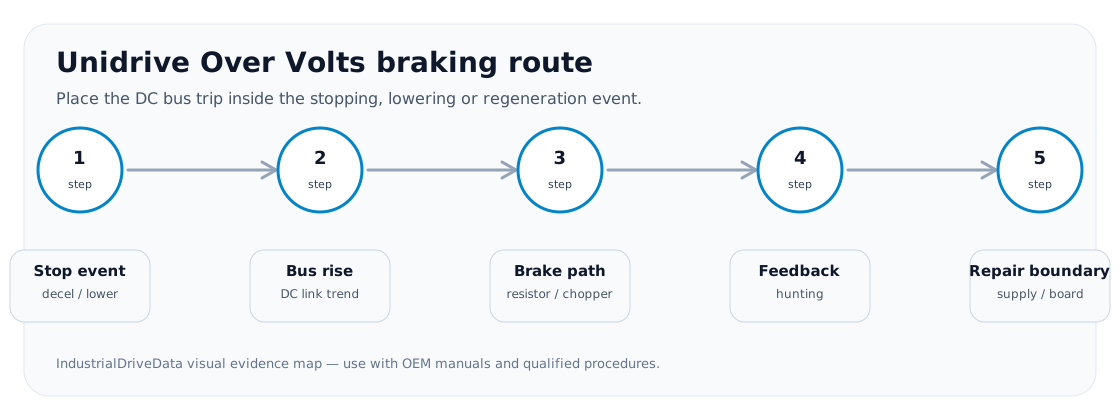
Service decision coverage
Over Volts users are usually troubleshooting a stopping/lowering event. The answer must explain regeneration and braking evidence before board suspicion.
| Observed situation | Decision needed | Evidence that satisfies the case |
|---|---|---|
| Trip during decel | Regeneration/load inertia | DC bus trend and decel time |
| Brake resistor fitted | Brake path condition | Resistor value and chopper evidence |
| Trip in closed-loop running | Feedback hunting | Encoder trace and open-loop comparison |
Over Volts as a machine-energy symptom
On Unidrive applications, Over Volts often appears during decel, lowering, unwind or hunting feedback. It is not automatically a failed DC-bus board; first prove whether the machine is returning energy faster than the drive/brake path can absorb it.
Over Volts evidence matrix
The event condition tells the route.
Unidrive Over Volts route
| Condition | First evidence | Hardware boundary |
|---|---|---|
| Decel/stop | Ramp and inertia | Brake resistor/chopper |
| Hoist lowering | Overhauling load and brake control | Braking/regeneration path |
| Closed-loop hunting | Encoder feedback/noise | Feedback path before brake hardware |
| Power-up/steady run | Line voltage/transient | Bus sensing/input path |
| After resistor replacement | Resistance/wiring/thermal | Chopper transistor/driver |
Repair boundary
A repair request should include the DC-bus event, ramp demand, load type, resistor/chopper evidence and feedback stability. Without feedback evidence, a closed-loop overvoltage case can be misrouted.
Field record checklist
- Event timing
- Load inertia
- Brake path
- DC-bus trend
- Feedback stability
Technical basis and reference documents
This is an independent editorial technical reference. Original manufacturer documentation remains controlling for installation, repair and commissioning decisions.
Trip-code source for Over Volts and DC-bus trip levels.
Diagnostic workflow
Turn this record into a qualified service request
A repair decision is much more reliable when the request includes the exact identity of the drive, the first fault evidence and the machine condition when the symptom appeared.
- Complete drive type code / MLFB or nameplate model
- Fault code, fault value and first event before reset
- When the event appears: power-up, enable, ramp, run, decel or stop
- Motor/cable connected or isolated during the symptom
- Visible board, option-card, module and connector identifiers
- Previous repair history, replacement parts and repeat-failure pattern