
Scope of this technical record
Siemens SIMOVERT MASTERDRIVES 6SE70 / 6SE71 coverage is focused on legacy line-drive service where F002, F006, F008, F011, CUVC/PMU/OP1S communication or common-DC-bus evidence must be routed before assemblies are replaced.
MASTERDRIVES systems include hazardous line, DC-link, regenerative and motor energy. Use this record only for qualified industrial drive service. Isolate, lock out and verify discharge before cabinet or board access.
MASTERDRIVES topology-to-repair evidence map
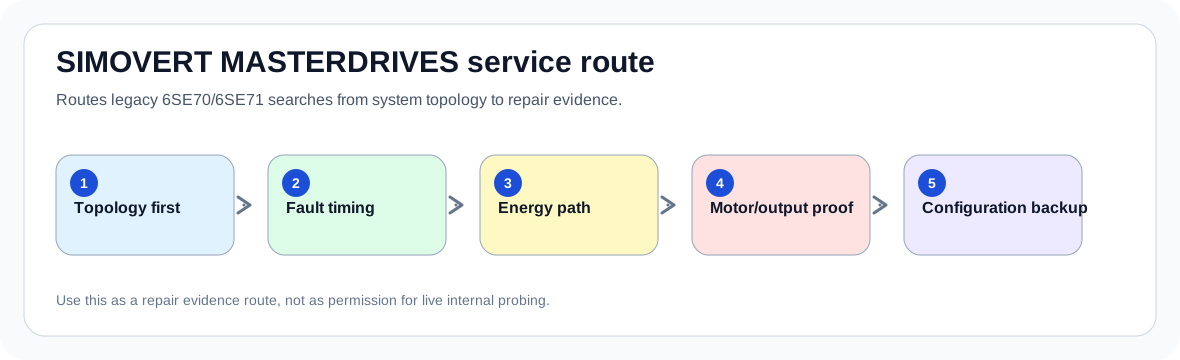
MASTERDRIVES service decision map
SIMOVERT MASTERDRIVES fault cases often involve older equipment where downtime is expensive and direct replacement is not simple. A fault name is not enough. The first decision is whether the case belongs to input/precharge, DC-link energy, regenerative braking, output-stage current, CUVC control, communication topology or a cabinet-level common-bus arrangement.
The 6SE70 device and 6SE71 cabinet context matters. A standalone AC/AC drive, a rectifier/inverter system and a multi-motor common-DC-bus system can produce similar symptoms while requiring different proof. The service route must therefore confirm system topology before any hardware replacement is recommended.
MASTERDRIVES service-routing map
| Symptom or fault | Service decision | Evidence needed | Repair risk if skipped |
|---|---|---|---|
| F002 precharging fault | Input, precharge, contactor or DC-link charge route | Line phase, precharge behaviour, DC-bus rise, fuses/contactors | Repeated energization into failed precharge or weak capacitors |
| F006 DC-link overvoltage | Regeneration, braking path, decel ramp or supply level | Stop event, bus value, braking unit/resistor, common-bus topology | Blaming the power board while the machine is regenerating energy |
| F011 overcurrent | Motor/cable/load versus output-stage and driver boundary | Trip timing, insulation proof, load condition, phase evidence | Replacing inverter modules before proving the motor/load path |
| USS / SIMOLINK / PROFIBUS fault | Protocol path, node identity, parameter backup or controller interface | Network topology photo, node list, CUVC/options, backup status | Restoring hardware but losing the machine configuration |
From fault wording to service route
Official documents identify the family, terminals and fault wording. This record turns that information into a repair route: first topology, then timing, then field boundary, then board boundary.
For legacy MASTERDRIVES equipment, the parameter set and communication path may be as valuable as the power board. The record therefore asks for PMU/OP1S status, DriveMonitor or PLC interface access, fault queue evidence and cabinet topology photos before it treats the drive as a simple part replacement.
Field record checklist
- Exact 6SE70 / 6SE71 type code
- Single drive, rectifier/inverter or common-DC-bus topology
- First fault and fault value before reset
- DC-link behaviour and input measurements
- Motor/cable/load status
- CUVC/options and communication protocol
- Parameter backup status and photos of cabinet topology
Technical basis and reference documents
This is an independent editorial technical reference. Original manufacturer documentation remains controlling for installation, repair and commissioning decisions.
Used for MASTERDRIVES family terminology, DC-link behaviour and fault-reference boundaries.
Used to align fault terminology; the guidance is written as a diagnostic evidence route, not a raw fault-code copy.
Model records
Platform reference distinguishing standalone 6SE70 units from integrated 6SE71 cabinet systems, and mapping converter, inverter, rectifier/regenerative and common-DC-bus configurations to diagnostic work.
Editorial circuit-map entry based on identified 6SE7021, 6SE7022 and 6SE7023 schematic sets, used to organize auxiliary supply, DC-link, IGBT-drive and status/protection signal investigations without distributing original drawings.
Fault records
The MASTERDRIVES system reports a motor-temperature warning/trip, or the temperature input behaves inconsistently after wiring, motor or board work.
A hoist, lift, crane or vertical axis does not release or hold correctly, or the drive/brake sequence causes movement, trip or mechanical shock.
The drive does not complete DC-link precharge within the monitored period and prevents normal enable.
The MASTERDRIVES unit trips as the DC-link voltage rises above the permitted limit, often under regeneration or deceleration.
The drive disables pulses because DC-link voltage is below the permissible level for operation.
The drive trips on excessive current; the OEM fault value can indicate the affected U, V or W phase in supported units.
Board and assembly records
Routes motor-temperature sensor and brake-control symptoms through terminal/expansion wiring, configured software response and external machine hardware.
Provides closed-loop and open-loop vector-control processing, parameterization interface context and communication linkage for SIMOVERT MASTERDRIVES Vector Control equipment.
Supplies electronics power in applicable MASTERDRIVES chassis equipment; loss or instability belongs in the control-power diagnostic boundary before condemning CUVC or the inverter power section.
Maps visible DC-link, auxiliary supply, IGBT drive and fault/status paths from identified schematic sheets into a structured diagnostic record.
Circuit and diagnostic records
Routes KTY84 and PTC motor-temperature evidence through terminal input, expansion-board context and configured warning/fault response.
Maps drive brake-control logic to relay output, brake coil supply, release/close delays and mechanical brake condition for hoist and vertical-axis applications.
Maps the line-side or common-DC supply path through precharge and DC-link energy management to the inverter, with diagnostic relevance for F002, F006 and F008.
Organizes local parameterization, operator-panel communication and synchronous drive-system data exchange around CUVC, PMU/OP1S, USS, SIMOLINK and PROFIBUS-DP contexts.
Editorial map of visible circuit relationships in identified 6SE7021 and 6SE7023 drawings, including DC-link supply, auxiliary rails, IGBT switching, fan supply and current/load/temperature status signals.
MASTERDRIVES reports motor-temperature warning/trip or inconsistent KTY/PTC sensor behaviour.
Brake does not release/close correctly, load slips, or the drive trips during brake sequence on a MASTERDRIVES application.
A MASTERDRIVES system stops with F002, F006 or F008, or cannot progress safely from precharge to operation.
The unit reports F011 or a suspected output-stage current event after start, acceleration or previous module repair.
A legacy MASTERDRIVES unit cannot be parameterized reliably, communication is lost, or a synchronized drive system no longer exchanges expected data.
Turn this record into a qualified service request
A repair decision is much more reliable when the request includes the exact identity of the drive, the first fault evidence and the machine condition when the symptom appeared.
- Complete drive type code / MLFB or nameplate model
- Fault code, fault value and first event before reset
- When the event appears: power-up, enable, ramp, run, decel or stop
- Motor/cable connected or isolated during the symptom
- Visible board, option-card, module and connector identifiers
- Previous repair history, replacement parts and repeat-failure pattern