
Scope of this technical record
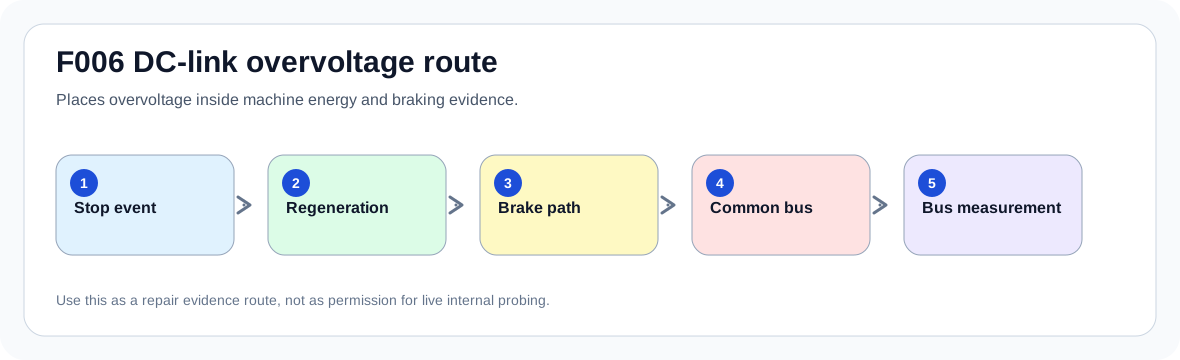
Routes Siemens MASTERDRIVES F006 overvoltage evidence through line voltage, deceleration energy, braking unit/resistor, regenerative/common-bus topology and DC-link measurement evidence.
A DC-link overvoltage event can involve regenerative energy and braking hardware. Do not repeatedly reset until the stopping event and energy path are understood.
F006 overvoltage energy-route image
First decision before troubleshooting
The useful F006 diagnosis is not just 'DC link too high'. The maintenance team has to prove why it went high: supply too high, deceleration ramp too aggressive, load regenerating, braking resistor or chopper unavailable, common-bus energy exchange or a measurement path issue.
On high-inertia machines, winders, hoists, test stands and common DC bus systems, F006 is often a machine-energy problem first. The record must make that visible before drive hardware replacement is considered.
Fault timing is the first diagnostic measurement
The same drive family can show the same code for different reasons depending on when the event appears. The first useful evidence is not the replacement part number; it is the first fault, the operating moment and the measured boundary at that moment.
A code list defines the label. A service record defines what must be proven before the next energization or hardware purchase.
Timing-to-action map
| Observed event | Most likely branch to prove | Evidence that closes the branch | Stop condition |
|---|---|---|---|
| During deceleration or OFF3 | Regenerative energy and ramp/brake path | Bus value during stop, decel time, braking unit/resistor state | Do not shorten ramps to hide production delay |
| During lowering/overhauling load | Four-quadrant or regenerative topology | Load direction, energy return path, common-bus context | Do not treat it like a static supply fault |
| At idle or power-up | Line supply or DC-link measurement | Input voltage and displayed/measured bus comparison | Do not blame braking resistor first |
| Only one axis in common bus | Energy exchange and bus coordinator | Which axis regenerates, which consumes, bus trip sequence | Do not replace the tripping inverter alone |
Repair boundary before replacing hardware
Legacy industrial drives are often repaired after production pressure has already caused several resets or swapped parts. The record therefore sets a boundary: prove the external energy path, the motor or field path, the command path and the measurement path before a board is treated as defective.
A good repair intake can often reject the wrong purchase. For example, a DC-link fault with missing input phase evidence is not a capacitor case yet; an overcurrent with a jammed load is not an inverter-board case yet; a field-loss code with open field wiring is not a control-board case yet.
Boundary proof table
| Boundary | What to check | What confirms it | What not to do |
|---|---|---|---|
| Machine energy | Identify inertia, lowering load or fast stop | Overvoltage follows stopping event | Condemn input rectifier first |
| Braking path | Check chopper, resistor, contactor and thermal link where fitted | Braking unavailable when bus rises | Fit a resistor without rating/topology review |
| Supply level | Measure incoming voltage and transformer setting | Bus high at idle with high line | Adjust only ramp while supply is excessive |
| Common bus | Map rectifier/regenerative unit and inverters | Another axis drives bus high | Troubleshoot one inverter in isolation |
Evidence package that makes the record actionable
A useful service record tells the technician what to collect next: model identity, first fault, trip timing, measurements, photos and repair history.
When this evidence is present, a service team can decide whether the next step is field wiring, supply correction, parameter recovery, board-level bench work, power-module verification or modernization planning.
Repair request evidence
| Evidence | Why it matters | Useful example |
|---|---|---|
| Stop-event log | Separates regeneration from static overvoltage | F006 appears only on fast stop |
| Brake hardware evidence | Confirms whether energy has a path | Resistor disconnected or chopper faulted |
| Topology photo | Common-bus arrangements change diagnosis | One rectifier feeds four inverters |
| Measured line/bus values | Avoids false measurement conclusions | Line high, bus high even at idle |
How this record supports a repair decision
Many fault-code references stop at the code definition. A practical service record has to connect the event to the field decision: inspect supply, DC bus, regenerative energy, motor cable, field circuit, communication topology, feedback measurement or board-level protection first.
This record keeps the path narrow. It converts the event into safe evidence, then states when the case becomes a board-level or component-level repair question before a drive is sent out or expensive parts are ordered.
Field record checklist
- Trip moment
- Load and stop sequence
- DC-bus value
- Braking hardware condition
- Common-bus topology
- Line voltage
- Previous ramp/brake parameter changes
Technical basis and reference documents
This is an independent editorial technical reference. Original manufacturer documentation remains controlling for installation, repair and commissioning decisions.
Used for MASTERDRIVES family terminology, DC-link behaviour and fault-reference boundaries.
Used to align fault terminology; the guidance is written as a diagnostic evidence route, not a raw fault-code copy.
Diagnostic workflow
Turn this record into a qualified service request
A repair decision is much more reliable when the request includes the exact identity of the drive, the first fault evidence and the machine condition when the symptom appeared.
- Complete drive type code / MLFB or nameplate model
- Fault code, fault value and first event before reset
- When the event appears: power-up, enable, ramp, run, decel or stop
- Motor/cable connected or isolated during the symptom
- Visible board, option-card, module and connector identifiers
- Previous repair history, replacement parts and repeat-failure pattern