
Scope of this technical record
Service hub for compact VLT 2800 / 2900 cases where display instability, overcurrent, earth fault, short circuit and board evidence must be separated before repair or replacement.
Qualified drive personnel only. Isolate AC line supply and verify DC-link discharge before removing covers, motor leads, keypad assemblies or internal boards.
Danfoss compact-drive service route
VLT 2800 / 2900 cases are routed by symptom and evidence before keypad, board or replacement decisions.
Danfoss VLT 2800 / 2900 compact-drive route
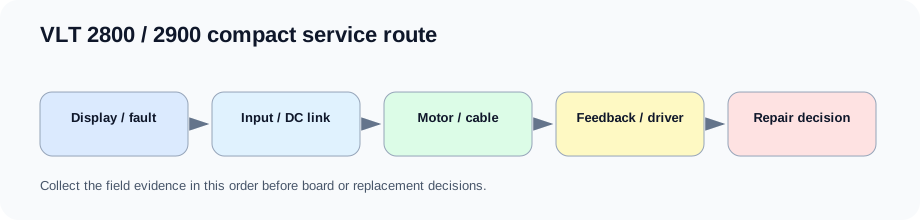
Choose the route from what the drive actually shows
A compact VLT 2800 / 2900 case should not start with a board order. The first route depends on whether the drive can boot, whether the display is stable, and whether the first fault is Alarm 13, Alarm 14 or Alarm 16.
Blinking display cases stay on the control-power route. Alarm 13 is split by timing and load. Alarm 14 starts at the motor/cable insulation boundary and moves inward only when no-motor evidence points to the drive. Alarm 16 is treated as a short-circuit stop condition until the output path is proven.
First route selector
| Observed case | Start with | Do not jump directly to |
|---|---|---|
| Blinking / partial display | Input, DC link, auxiliary supply, +5 V / +24 V and keypad load | Keypad or control-board replacement |
| Warning / Alarm 13 | Trip timing, motor shaft, load, ramp and current-limit evidence | Output module replacement |
| Alarm 14 | Motor cable, motor insulation, PE / shield and no-motor current evidence | Current sensor or power-board replacement |
| Alarm 16 | U/V/W terminal, cable, motor winding and output accessory short-circuit proof | Reset and re-run |
| Repeat failure after repair | DC link, driver supply, gate channels, motor/cable proof and repair history | Another module only |
Compact drives need repair-versus-replace evidence
VLT 2800 and VLT 2900 drives are often old enough that service work includes a replacement decision. A useful service package records the type code, power size, board label, first fault, display behavior, motor/cable proof and previous repair history.
A donor drive or board is most useful when the original fault boundary is known. If a shorted motor cable, overloaded reference supply or unstable auxiliary supply is missed, replacement hardware can fail or repeat the same symptom.
Field record checklist
- Type code
- Power size
- Display pattern
- Fault number
- Trip timing
- Motor/cable insulation evidence
- Input and DC-link evidence
- Board labels
- Previous repair history
Technical basis and reference documents
This is an independent editorial technical reference. Original manufacturer documentation remains controlling for installation, repair and commissioning decisions.
Confirms Alarm 13 overcurrent, Alarm 14 earth fault, Alarm 16 current short circuit, input-phase and DC-link alarm boundaries used to structure the first service routes.
Documents VLT 2800 warning and alarm text including Alarm 13 peak current, Alarm 14 ground fault, Alarm 15 switch-mode supply and Alarm 16 short-circuit cautions.
Provides practical Alarm 14 separation between motor/cabling evidence and drive-side current-sensor evidence, including no-motor current observations and manual-initialization caution.
Model records
The VLT 2800 CB1-CB3 control-board family is used for cases where the panel blinks, the display is incomplete, keypad replacement does not clear the symptom, a 10 V reference is loaded, or the low-voltage rails need to be separated from a downstream I/O or keypad load.
The VLT 2900 DB1-DB4 drawing family is used for compact Danfoss cases where Alarm 13, Alarm 14, Alarm 16 or repeat output-stage repair decisions need the DC link, auxiliary supply, gate-drive and current-feedback boundaries separated.
The VLT 2800 CB1-CB3 drawing set exposes +5 V, +24 V, VREF and keypad/display-related logic paths useful when the drive has a blinking display, partial display, I/O reference problem or control-card suspicion.
The VLT 2900 DB1-DB4 drawing set shows DC input references, auxiliary rail generation, optically isolated or buffered signal paths and six-channel gate-driver relationships relevant to overcurrent, internal short and post-repair pre-power checks.
Fault records
The VLT 2800 display blinks, shows only partial segments, restarts during power-up or remains unstable even after keypad replacement.
The compact VLT reports Alarm 13 or Warning 13 when the motor is started, during acceleration, under load or immediately at PWM output.
The drive trips with Alarm 14 during start, immediately after reset, with the motor connected, or even when the motor has been disconnected for testing.
The VLT 2800 / 2900 reports Alarm 16 on start, immediately after output enable, after motor work, after cable changes or after a prior power-stage repair.
VLT 2800 reports DC LINK UNDERVOLT or trips before the motor can be run reliably.
The drive trips on overcurrent during start, acceleration or under load.
The drive reports earth fault or trips when the output is energized.
The drive reports internal or output short-circuit and may trip immediately at run command.
The VLT 2800 display blinks, only one digit illuminates or the LCP/panel replacement does not clear the symptom.
Board and assembly records
Provides compact-drive control electronics, keypad/display interface, low-voltage logic and I/O reference paths used when diagnosing blinking display or weak control supply behavior.
Supports output-stage service decisions for Alarm 13, Alarm 14, Alarm 16 and repeat compact-drive output failures by separating DC-link, gate-driver and current-feedback evidence.
Collects the evidence needed before deciding whether a compact VLT 2800 / 2900 should be repaired, used as a donor-board case, replaced with a used drive or modernized.
Organizes +5 V, +24 V, VREF, display/alarm and low-voltage I/O evidence for blinking-display or control-card suspicion.
Maps auxiliary rails, DC input references, isolated driver feedback and multi-channel gate-drive relationships for short-circuit and overcurrent escalation.
Circuit and diagnostic records
Low-voltage route for VLT 2800 blinking-display and control-board cases: DC-link feed, auxiliary supply start-up, +5 V logic, +24 V control, 10 V reference, keypad interface and external I/O load must be separated.
Energy path for compact Danfoss cases where DC-link undervoltage, display instability or power-board suspicion must be separated from input fuses, rectifier, DC link and auxiliary supply behavior.
Output-stage route for Alarm 13, Alarm 14 and Alarm 16 cases after external motor, cable and terminal evidence has been collected. The route connects gate-drive channels, driver supply, current feedback and output module decisions.
CB drawings expose +5 V, +24 V and VREF-related regions that help separate display initialization, keypad connection and control-card loading questions.
DB1 shows power-source and auxiliary rail evidence that supports undervoltage and post-repair rail-stability questions.
DB2-DB4 show isolated and buffered driver/feedback regions with rails and gate-signal families used when Alarm 13, 14 or 16 requires internal escalation.
Blinking, partial or unstable VLT 2800 display after power-up, keypad swap or repeated power cycling.
Alarm 13 overcurrent or Alarm 14 earth fault on a VLT 2800 / 2900 compact drive during start, ramp, run or bench test.
Alarm 16 short circuit, repeat output-stage failure or post-repair uncertainty on compact Danfoss VLT 2900 hardware.
Blinking, partial or non-initializing VLT 2800 display after keypad replacement or power cycling.
Warning/Alarm 13 or Alarm 14 during run command, acceleration or output energization.
Alarm 16 current short-circuit, repeat module failure or post-IGBT repair risk.
Turn this record into a qualified service request
A repair decision is much more reliable when the request includes the exact identity of the drive, the first fault evidence and the machine condition when the symptom appeared.
- Complete drive type code / MLFB or nameplate model
- Fault code, fault value and first event before reset
- When the event appears: power-up, enable, ramp, run, decel or stop
- Motor/cable connected or isolated during the symptom
- Visible board, option-card, module and connector identifiers
- Previous repair history, replacement parts and repeat-failure pattern