
Scope of this technical record
A focused series page for FRENIC5000 G9/G11 repair cases where module replacement alone has not solved the failure or where an integrated rectifier/inverter package creates an economic repair boundary.
Only qualified repair benches should use the evidence routes below. Do not energize high-voltage bus circuits or modified module connections from a web page.
FRENIC G9/G11 repeat-failure route
The series route separates the cause of repeat failure before a scarce replacement module is energised.
FRENIC G9/G11 repair evidence map
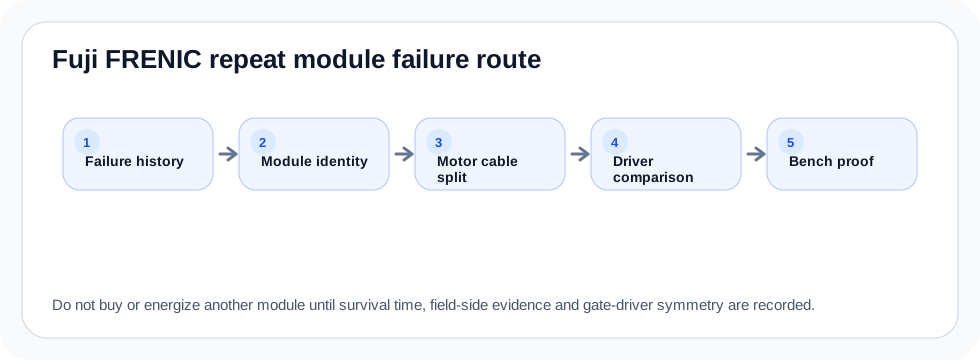
FRENIC5000 G9/G11 service evidence required
The technician is often not looking for a menu parameter. They need to know why a replacement module failed, whether a rectifier-only fault justifies a specialist repair path, or why output is unbalanced even though the power module has been changed.
The series page is written around that repair moment. It does not promise that all old modules are recoverable; it gives the intake evidence needed to avoid buying another part before the destructive cause is known.
Decision map
The first split is not brand or power rating. The first split is whether the fault belongs to the external output path, the replacement module, the driver channel, or the input/DC-link side.
FRENIC repair split
| Observed event | First suspicion | What confirms or rejects it |
|---|---|---|
| Module dies instantly | Output short, wrong module, driver channel hard fault | Output isolated result, module marking, driver rail comparison |
| Module lasts days | Leakage/aging in driver support components | Small capacitor and optocoupler evidence, channel waveform comparison |
| Only rectifier side tests bad | Input surge/precharge/DC link issue | Input diode tests, varistor/precharge evidence, capacitor condition |
| Output unbalanced after repair | Driver current capability or feedback asymmetry | Six-channel waveform and phase comparison |
Why this can beat case-result summaries
A fault-code list cannot answer whether a replacement module will survive. The page asks for the evidence that changes the repair risk: survival time, channel comparison, external load isolation and module-source credibility.
This makes the page more useful than a manual excerpt for repair buyers and technicians. It converts case service requests into a high-quality repair request, not just another definition of overcurrent.
Field record checklist
- Module part number and photographs
- Replacement supplier/condition
- Survival time after replacement
- External motor/cable test result
- Driver board close-ups around the failed phase
Technical basis and reference documents
This is an independent editorial technical reference. Original manufacturer documentation remains controlling for installation, repair and commissioning decisions.
Used for family context and safety constraints.
Used for repeated-module and rectifier-section repair-service mapping.
Model records
Fault records
Fuji FRENIC G9/G11 drive works briefly after a module replacement, then fails again, trips on output faults, produces unbalanced output, or damages another module under load.
Older Fuji or Japanese VFD module shows input/rectifier damage while the inverter section may still test differently, creating a repair-versus-replace decision for an expensive or scarce integrated module.
Board and assembly records
Captures the evidence needed when a tiny driver-side capacitor, optocoupler or gate component causes repeat module failure without obvious burn marks.
Documents why controlled load and reduced stored energy are used to protect scarce modules while verifying a repaired output stage.
Circuit and diagnostic records
Maps the service-decision path for repeated Fuji G9/G11 module failures: PWM command, optocoupler/driver output, small capacitor leakage, zener/gate resistor condition, module input capacitance and motor/load evidence.
A public safety-oriented map of why experienced repair benches reduce stored energy and use controlled load evidence before proving an output stage after destructive module repair.
A VFD module has already been replaced once or more and the drive still fails, trips, produces unbalanced output, or destroys the replacement module.
A legacy integrated module appears to have rectifier/input-side damage while the inverter section may not show the same evidence.
Turn this record into a qualified service request
A repair decision is much more reliable when the request includes the exact identity of the drive, the first fault evidence and the machine condition when the symptom appeared.
- Complete drive type code / MLFB or nameplate model
- Fault code, fault value and first event before reset
- When the event appears: power-up, enable, ramp, run, decel or stop
- Motor/cable connected or isolated during the symptom
- Visible board, option-card, module and connector identifiers
- Previous repair history, replacement parts and repeat-failure pattern