
Scope of this technical record
For older integrated modules where the input rectifier section is damaged and the repair buyer wants to know whether full module replacement, specialist repair or drive replacement is the responsible route.
This is not a modification recipe. It is an evidence standard for deciding whether a specialist repair conversation is justified.
Rectifier-section repair decision route
Rectifier-only damage is an evidence question, not a public modification recipe.
Rectifier-section repair decision image
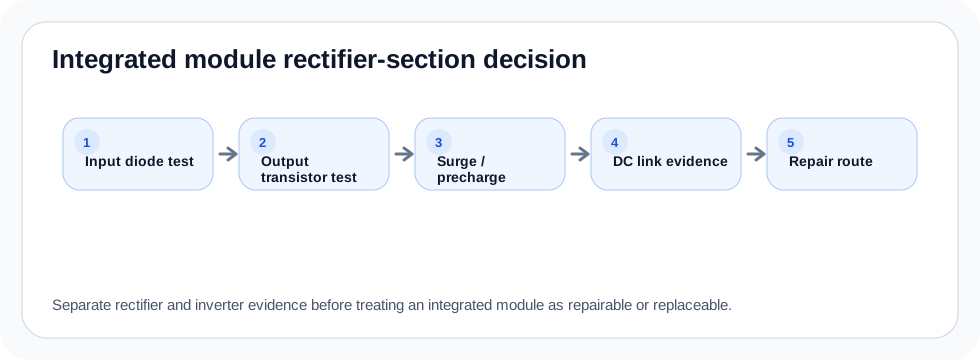
Service decision coverage
Rectifier-only damage attracts unsafe shortcuts. This page turns the case into an evidence-based repair-versus-replace decision.
| Observed field situation | Decision the technician needs | Evidence to collect |
|---|---|---|
| Input side shorted | Determine whether the inverter section is also damaged | Separate diode/transistor tests |
| Breaker did not trip fast | Check surge and varistor/precharge damage | Fuse, MOV, precharge and capacitor evidence |
| Module scarce or expensive | Compare full replacement, specialist repair and modernization | Exact module marking and section test result |
Why rectifier-section cases are different
Integrated power modules can combine the rectifier and inverter sections. If only the input rectifier group appears damaged, the repair economics are different from a fully shorted output bridge. But that does not automatically make a partial repair responsible.
The cause of the input-side failure still matters: line surge, varistor short, precharge problem, weak breaker action, capacitor failure or wiring damage can destroy the next repair if left unresolved.
Evidence standard
The repair record should show why rectifier-only damage is suspected and why the rest of the power path can or cannot be trusted.
Rectifier-section evidence
| Evidence area | Why it matters | What to capture |
|---|---|---|
| Input diode group | Confirms whether damage is input-side dominant | Meter results by terminal group |
| Output transistor group | Prevents trusting a damaged inverter stage | Static leakage/short evidence |
| Surge / varistor / precharge | Explains why the rectifier failed | Photos, fuse result, precharge components |
| DC capacitors | Protects the next repair from stored-energy and ripple stress | Capacitance/ESR/visual findings |
| Module identity | Prevents wrong substitute decisions | Exact marking and package photo |
Service decision
If the rectifier side is isolated damage and the rest of the drive has clean evidence, a specialist repair path may be discussed. If the inverter stage, capacitors or line-protection cause is ambiguous, full replacement or modernization may be cheaper than repeated attempts.
The page is deliberately conservative because many readers will be tempted to copy a one-off repair trick. IndustrialDriveData uses the case as a decision framework, not as public field wiring guidance.
Field record checklist
- Module package and terminal photos
- Input diode test result
- Output transistor test result
- Varistor/precharge/capacitor evidence
- Upstream breaker/fuse event
Technical basis and reference documents
This is an independent editorial technical reference. Original manufacturer documentation remains controlling for installation, repair and commissioning decisions.
Used for equipment-family context and safety constraints.
Used for integrated-module repair economics and rectifier-section evidence routing.
Diagnostic workflow
Turn this record into a qualified service request
A repair decision is much more reliable when the request includes the exact identity of the drive, the first fault evidence and the machine condition when the symptom appeared.
- Complete drive type code / MLFB or nameplate model
- Fault code, fault value and first event before reset
- When the event appears: power-up, enable, ramp, run, decel or stop
- Motor/cable connected or isolated during the symptom
- Visible board, option-card, module and connector identifiers
- Previous repair history, replacement parts and repeat-failure pattern