
Legacy FRENIC VFD repair / power-stage evidence
Focused repair-case coverage for legacy FRENIC5000 G9 / G11 drives, prioritizing repeated power-module failure, gate-driver leakage, rectifier-section module damage and safe bench evidence before another module is fitted.
Scope of this technical record
Fuji Electric coverage is currently focused on the older FRENIC5000 G9/G11 repair problem that basic fault-code notes handle poorly: repeated module failure after replacement and rectifier-section damage inside scarce integrated modules.
This page is not a field modification guide. It is a repair-intake and evidence-routing reference for qualified industrial-drive personnel.
Fuji repair-intent route
The Fuji cluster starts from the repair buyer's question: will another module survive?
Fuji repeated-module evidence map
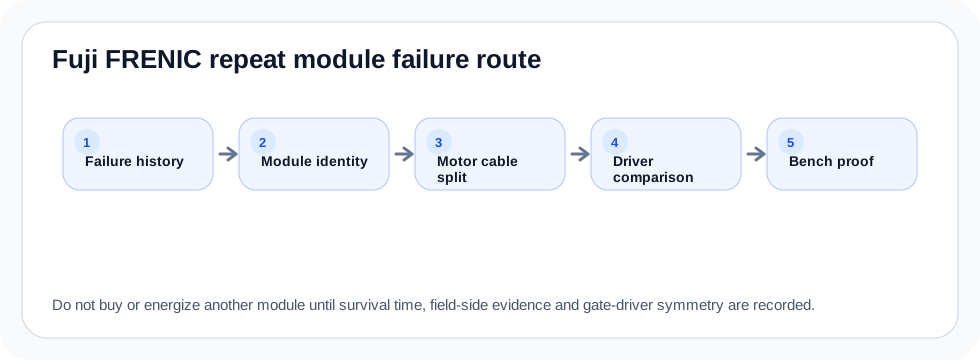
Why this brand cluster is not a generic Fuji page
Most public material around FRENIC drives stops at manuals, model selection or fault-code summaries. The repair case usually arrives later, after a module has already failed, a replacement has been fitted, and the new module has either failed again or produced unstable output.
The coverage therefore starts with repeat-failure economics. A scarce or expensive module should not be treated as the next experiment. The useful page must force the repair record to identify the driver channel, field-side output path and module source before another power stage is powered.
High-value field cases this cluster supports
The cluster deliberately serves repair-shop and maintenance cases rather than classroom questions.
Field service case to evidence route
| Field situation | What the page must decide | Evidence that supports a reliable service decision |
|---|---|---|
| G9/G11 burns module again | Driver leakage, module quality or motor/cable cause | Survival time, six-channel comparison, output isolation result |
| Works for days then fails | Small-component leakage or marginal gate drive | Capacitor leakage, optocoupler aging, waveform asymmetry |
| Rectifier part of module failed | Full replacement or specialist repair route | Separate rectifier/inverter section evidence and surge cause |
| No safe bench proof after repair | How to avoid another destructive test | Reduced-energy/fake-load evidence and stop condition |
Repair request qualification
A serious Fuji request should include exact type code, module marking, replacement source, how long the replacement survived, whether the fault repeats with the output path isolated, and clear photographs of the driver area around the affected leg. Without that information the best answer is still only a fault category.
The business value of this cluster is that it turns an ambiguous 'bad module' inquiry into a structured repair decision: field fault, module sourcing issue, driver board repair, input surge/precharge problem or modernization.
Field record checklist
- Full drive type and module marking
- Original and replacement module history
- Trip timing and survival time
- Motor/cable isolation result
- Driver-channel evidence photos
Technical basis and reference documents
This is an independent editorial technical reference. Original manufacturer documentation remains controlling for installation, repair and commissioning decisions.
Used for product family and safety context; repair conclusions require the installed drive evidence.
Used to structure repeat-module and small-component leakage evidence without redistributing underlying repair documents.
Available series
Turn this record into a qualified service request
A repair decision is much more reliable when the request includes the exact identity of the drive, the first fault evidence and the machine condition when the symptom appeared.
- Complete drive type code / MLFB or nameplate model
- Fault code, fault value and first event before reset
- When the event appears: power-up, enable, ramp, run, decel or stop
- Motor/cable connected or isolated during the symptom
- Visible board, option-card, module and connector identifiers
- Previous repair history, replacement parts and repeat-failure pattern