
Scope of this technical record
For users who have already replaced an IGBT/PIM module in an older Fuji G9/G11-style drive and now face repeated failure, output imbalance or uncertainty about whether the next module will survive.
Repeated power-module failure is a stop condition. Do not continue full-energy power-ups without a controlled field-side and driver-side boundary check.
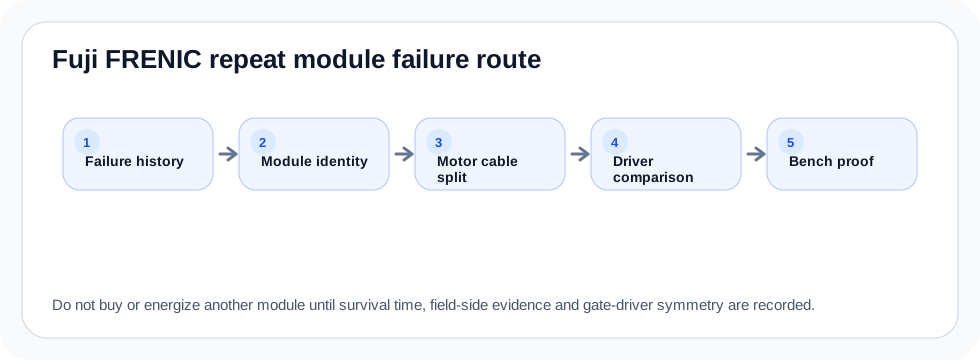
Repeated module failure route
A repeated module failure is a stop condition until driver-channel and load evidence are reconciled.
Repeated IGBT failure evidence image
Service decision coverage
These cases often arrive after money has already been spent on a module. This record separates a valid repair from another uncontrolled experiment.
| Observed field situation | Decision the technician needs | Evidence to collect |
|---|---|---|
| Module failed again immediately | Stop full-energy testing and split hard short from driver fault | Output isolation, module marking, gate rail comparison |
| Module worked briefly then failed | Look for leakage/aging in driver support parts | Small capacitor, optocoupler, gate resistor and waveform evidence |
| Output unbalanced after repair | Compare all six driver channels | U/V/W upper-lower channel symmetry and current feedback |
First decision before board repair
The phrase 'IGBT failed again' hides several different problems. The replacement module may be counterfeit or weak, the motor cable may still be damaged, the driver channel may be leaking, or the current feedback/protection path may be forcing destructive switching behaviour.
A useful repair page must therefore start with timing. Instant failure, failure during the first loaded run, and failure after several days do not point to the same next check. A drive that works briefly and then destroys a module is especially suspicious for marginal driver components such as aging optocouplers, zener clamps, gate resistors or small capacitors near the gate-drive path.
Timing-based repair table
Use the table before ordering another module.
Repeat-module decision table
| Failure timing | Likely boundary | Evidence that matters | Stop condition |
|---|---|---|---|
| Instant on enable | Hard short, wrong module, severe driver fault | Static output check, module identity, gate rail comparison | Any output short or missing negative bias |
| During acceleration/load | Motor/cable/load or weak driver current | Insulation test, load condition, gate waveform under command | Fault repeats with output path isolated |
| After days of running | Leakage/aging in small driver components | Capacitor leakage, optocoupler age, channel asymmetry | Replacement history repeats on same phase |
| Unbalanced output after repair | One gate channel cannot charge/discharge properly | U/V/W phase comparison, driver output shape | Any channel deviates from its matched pair |
Driver components that deserve attention
The driver is not only a voltage signal. It must deliver transient gate current into the IGBT input capacitance and then remove charge cleanly. A visually normal board can still under-drive one phase if a support capacitor leaks, a gate resistor has shifted, a clamp diode is damaged or an optocoupler output is weak.
That is why the page emphasizes channel comparison. A single measured value is less useful than six matched driver paths measured under the same condition. The repair record should state what was compared and what differed.
Evidence before a repair quote
A qualified request should include photos of the failed and replacement modules, board photographs around the affected leg, a note on how long the replacement ran, the first fault shown, motor/cable test results and whether the same phase failed again.
With that evidence the response can be precise: field correction, module sourcing warning, driver board repair, current-feedback investigation or drive replacement. Without it, the safest answer is not to sell another module.
Field record checklist
- Exact module marking
- Replacement source and run time
- First trip/failure condition
- Affected phase if known
- Motor/cable insulation evidence
- Driver-board close-up photos
Technical basis and reference documents
This is an independent editorial technical reference. Original manufacturer documentation remains controlling for installation, repair and commissioning decisions.
Used for family and safety context.
Used for repeated module failure, driver small-component leakage and fake-load evidence routing.
Diagnostic workflow
A VFD module has already been replaced once or more and the drive still fails, trips, produces unbalanced output, or destroys the replacement module.
Replacement IGBT, IPM or output module fails again during power-up, enable or early load testing.
Turn this record into a qualified service request
A repair decision is much more reliable when the request includes the exact identity of the drive, the first fault evidence and the machine condition when the symptom appeared.
- Complete drive type code / MLFB or nameplate model
- Fault code, fault value and first event before reset
- When the event appears: power-up, enable, ramp, run, decel or stop
- Motor/cable connected or isolated during the symptom
- Visible board, option-card, module and connector identifiers
- Previous repair history, replacement parts and repeat-failure pattern