
Scope of this technical record
Explains why controlled fake-load and reduced-energy evidence are used after destructive module repair, and what record should exist before a drive is exposed to full DC-link stored energy again.
This is not an instruction to improvise a test rig. Bench proof must be designed by qualified repair personnel using appropriate isolation, discharge and measurement equipment.
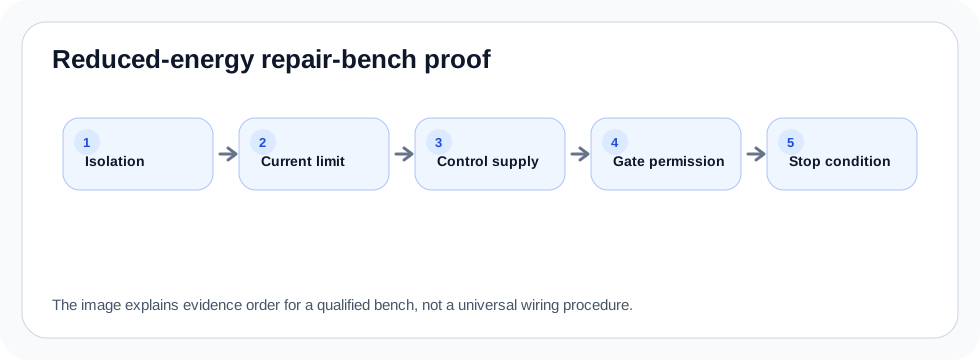
Bench reduced-energy proof route
The map shows evidence order, not a universal bench wiring instruction.
Reduced-energy bench proof image
Service purpose of this record
A repaired output stage can be destroyed by the first careless full-energy test. Experienced repair benches therefore seek evidence at lower risk: control power behaviour, driver permission, output-balance logic and current-limited input response before trusting the full capacitor bank.
The exact fake-load location matters. If placed incorrectly, it can mislead the drive into undervoltage behaviour or fail to protect the part of the circuit that actually needs protection. The page records the principle and evidence standard without turning it into unsafe universal wiring advice.
Bench evidence table
The evidence should make the repair less destructive, not just make the lamp glow.
Controlled proof record
| Evidence | Purpose | Bad sign |
|---|---|---|
| Current-limited input behaviour | Prevents immediate destructive current | Limit device bright/stressed unexpectedly |
| Control supply state | Confirms logic can boot under the test boundary | Supply collapses or oscillates |
| DC-link sense position | Prevents misleading undervoltage conclusions | Drive trips because the bus sense is not credible |
| Gate waveform permission | Shows whether the board is commanding the bridge | One channel missing or distorted |
| Output-balance indication | Confirms no gross phase asymmetry before full energy | One phase absent or abnormal |
Field record checklist
- Test boundary description
- Current-limit observation
- Control supply result
- Gate permission result
- Stop condition used
Technical basis and reference documents
This is an independent editorial technical reference. Original manufacturer documentation remains controlling for installation, repair and commissioning decisions.
Used to structure low-energy proof and fake-load evidence boundaries.
Turn this record into a qualified service request
A repair decision is much more reliable when the request includes the exact identity of the drive, the first fault evidence and the machine condition when the symptom appeared.
- Complete drive type code / MLFB or nameplate model
- Fault code, fault value and first event before reset
- When the event appears: power-up, enable, ramp, run, decel or stop
- Motor/cable connected or isolated during the symptom
- Visible board, option-card, module and connector identifiers
- Previous repair history, replacement parts and repeat-failure pattern