
Scope of this technical record
ACS800 page depth for ACS800 model-family identification, focused on interface evidence, output-stage evidence and repair-versus-replace routing.
This record is for qualified industrial-drive personnel. Isolate the drive, verify stored DC energy is discharged and follow the manufacturer manual before measuring inside the converter or touching motor, brake, field or control wiring.
ACS800 family identification route
The physical arrangement changes how the same indication is routed.
ABB acs800 01 04 07 evidence image
What this ACS800 page must decide
This page deepens the ACS800 route for ACS800 model-family identification. ACS800 faults become expensive quickly because a panel indication may involve RMIO supply, PPCC communication, INT/AINT interface electronics, PBU branching, AGDR-linked driver hardware, motor cable or the inverter power module.
The page therefore starts with localisation evidence and interface boundaries. A technician should be able to decide whether the case is still external, in the control/interface path, or at the output power-stage boundary before ordering a board or power module.
ACS800 evidence boundaries
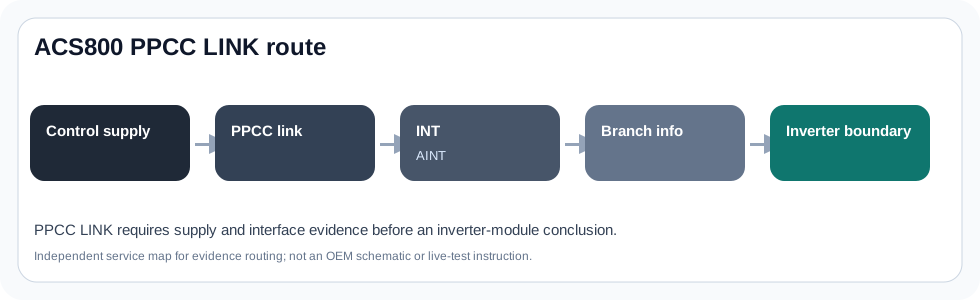
PPCC LINK cases are not the same as SHORT CIRC cases. PPCC LINK requires control-board supply, fibre/galvanic link and INT/AINT/PBU branch evidence. SHORT CIRC requires motor/cable checks, phase localisation and power semiconductor evidence. The page keeps these routes separate.
The field route also records when the fault appeared: power-up, first run command, under load, after cabinet service, after fibre replacement or after a power module was changed. That timing often decides whether the visible fault is primary or secondary.
ACS800 route matrix
| Indication | First route | Escalation evidence |
|---|---|---|
| PPCC LINK 5210 | RMIO supply and PPCC medium | Signal/branch information, INT/AINT/PBU identity, prior fibre/board work |
| SHORT CIRC 2340 | Motor cable and output bridge | Phase information, IGBT/static checks, AGDR or driver relationship |
| After module replacement | Driver and unresolved field cause | Driver-channel evidence, failed-part photos, no-load proof |
| Intermittent cabinet issue | Supply, fan, connector and fibre handling | Door movement, dust/connector photos, control supply state |
Service route
Use this model page to separate wall-mounted, module and cabinet arrangements because the same display code can travel through different physical interface paths.
The page does not claim that a particular board is always bad. It defines what evidence is needed before the ACS800 case becomes a repair, replacement or modernization decision.
Field record checklist
- Complete ACS800 type code, frame and cabinet/module arrangement
- Exact fault text/code and timing
- PPCC / branch information where available
- Motor/cable isolation result for output faults
- Board/module labels and prior repair history
Technical basis and reference documents
This is an independent editorial technical reference. Original manufacturer documentation remains controlling for installation, repair and commissioning decisions.
Official source for PPCC LINK, SHORT CIRC, FAULTED INT INFO, INT SC INFO, automatic reset and line-converter references.
Field discussions confirm why PPCC LINK cases often need connector, fibre, power-supply and board-branch evidence rather than immediate module replacement.
Related technical records
The ACS800 reports SHORT CIRC / 2340 at enable, first PWM, acceleration, steady operation or after a repaired module is returned to service.
The ACS800 displays PPCC LINK / 5210, sometimes with a module suffix or branch clue, and the drive cannot safely continue output operation.
The ACS800 reports PPCC LINK, commonly as code 5210, and output operation is blocked or unreliable.
The ACS800 trips on SHORT CIRC during an enable/start attempt or immediately under load.
This path separates control/interface command, AGDR driver health, isolated driver supply, gate output, IGBT phase-leg condition and motor-output evidence after an ACS800 SHORT CIRC event.
The PPCC path connects the control side to inverter-interface electronics. Service evidence must keep control supply, PPCC medium, INT/AINT interface and PBU branch routing separate.
The PPCC diagnostic path links control electronics to inverter interface electronics. A credible repair record must treat supply state, link medium, interface-board status and parallel-module branching as separate test regions.
For applicable higher-power ACS800 hardware, the AGDR-linked driver/module assembly is a repair-critical boundary between the inverter interface control path and the power semiconductor switching stage.
ACS800 SHORT CIRC / 2340 appears during enable, first PWM, acceleration, load operation, or after an output-stage repair.
An ACS800 displays PPCC LINK / 5210, with or without a module suffix, after power-up, reset, output enable or a previous board/module repair.
An ACS800 displays PPCC LINK / 5210 or a parallel inverter module reports a PPCC link suffix.
An ACS800 reports SHORT CIRC / 2340, particularly after a failed module or when a replacement power component is under consideration.
Turn this record into a qualified service request
A repair decision is much more reliable when the request includes the exact identity of the drive, the first fault evidence and the machine condition when the symptom appeared.
- Complete drive type code / MLFB or nameplate model
- Fault code, fault value and first event before reset
- When the event appears: power-up, enable, ramp, run, decel or stop
- Motor/cable connected or isolated during the symptom
- Visible board, option-card, module and connector identifiers
- Previous repair history, replacement parts and repeat-failure pattern