
Scope of this technical record
Use this record when ACS800 PPCC LINK / 5210 appears and the service decision must separate control supply, link medium, inverter-interface branch and power-stage boundaries.
Do not repeatedly enable output with PPCC LINK active. Isolate and discharge the drive before touching fibre, galvanic links, internal connectors or boards.
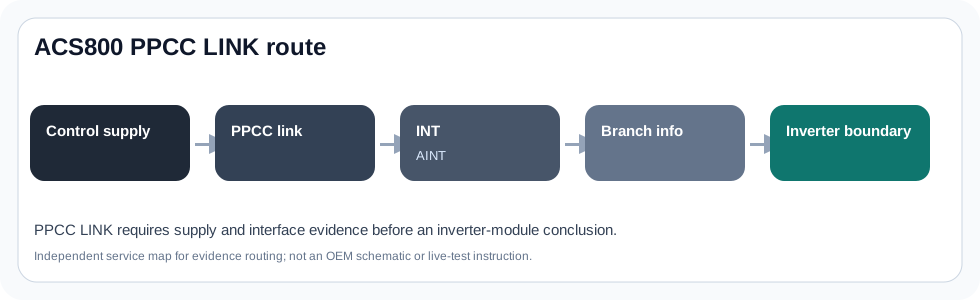
ACS800 PPCC LINK route
PPCC LINK is an interface evidence problem before it is an inverter-module claim.
ACS800 PPCC LINK interface image
Service decision coverage
PPCC LINK users need to know which interface boundary failed. The page is built to avoid a blind inverter-module replacement.
| Observed situation | Decision needed | Evidence that satisfies the case |
|---|---|---|
| Fault at power-up | Control supply or link establishment | Control-power context, link type and connector evidence |
| Fault tied to one branch | INT/AINT or branch-unit route | Faulted branch information and module identity |
| Fault after repair | Wrong link component or harness issue | Before/after photos and replacement history |
What PPCC LINK is telling the technician
PPCC LINK is a control-to-inverter interface problem before it is a power-module proof. The panel message says the control side does not have a credible communication/status path to the inverter side. That path can fail because a control-board supply is wrong, a link is damaged, an interface board is not ready, or a branch in a larger system is not mapped correctly.
The first service job is to prevent the fault label from becoming a blind parts request. A good intake record explains when the fault appears, which control unit is fitted, whether external 24 V is used, what the link medium is, and whether a branch or module clue exists.
Timing changes the first check
A PPCC fault that appears immediately at control power-up points toward control supply, external 24 V arrangement, link readiness or interface-board wake-up. A fault that appears after a previous module repair points toward cable routing, branch mapping, connector seating or mixed hardware. A fault reported with another destructive output indication must pause the PPCC route until the output-stage safety boundary is handled.
If the fault carries a suffix or module clue, the record should identify the physical branch before moving boards. The visible fault may be correct about where communication was lost without proving which board is defective.
PPCC LINK first evidence matrix
| Fault situation | Likely first route | Stop before |
|---|---|---|
| At control power-up | RMIO/RDCU supply and link readiness | Changing INT/AINT boards |
| After fibre or board work | Connector, branch and original cable route | Another board order |
| With module suffix | INT/AINT/PBU mapping | Unrelated module exchange |
| With SHORT CIRC | Output-stage stop route | Repeated powered reset |
Actionable evidence package
A useful PPCC request includes the complete ACS800 type code, frame, panel fault text, power state when the fault appears, control-board supply arrangement, board labels and clear photos of the link route. If the system has multiple inverter modules, the photos must show branch routing and module identity.
With those facts, the service route can be narrowed to field connector work, control-supply repair, RMIO/RDCU assessment, INT/AINT/PBU branch work or controlled modernization planning. Without those facts, the correct answer is evidence gathering, not a parts quote.
Field record checklist
- Complete fault text
- Fault timing
- RDCU/RMIO label
- External 24 V state
- INT/AINT/PBU route
- Branch/module photo
- Previous repairs
Technical basis and reference documents
This is an independent editorial technical reference. Original manufacturer documentation remains controlling for installation, repair and commissioning decisions.
OEM basis for ACS800 fault messages, PPCC LINK context and interface-related status evidence.
OEM basis for cabinet-drive hardware safety, RMIO/control-board and module arrangement context.
Public field-service discussion showing why fibre-link condition and control-power readiness can matter in PPCC diagnosis.
Diagnostic workflow
An ACS800 displays PPCC LINK / 5210, with or without a module suffix, after power-up, reset, output enable or a previous board/module repair.
The ACS800 panel is dark, unstable, externally powered, or reports PPCC-related trouble during a control-power transition.
A PPCC LINK case, cabinet drive or parallel inverter arrangement points toward a specific interface branch, INT/AINT board or module route.
Turn this record into a qualified service request
A repair decision is much more reliable when the request includes the exact identity of the drive, the first fault evidence and the machine condition when the symptom appeared.
- Complete drive type code / MLFB or nameplate model
- Fault code, fault value and first event before reset
- When the event appears: power-up, enable, ramp, run, decel or stop
- Motor/cable connected or isolated during the symptom
- Visible board, option-card, module and connector identifiers
- Previous repair history, replacement parts and repeat-failure pattern