
Scope of this technical record
Use this path to follow ACS800 PPCC evidence from control power through the link and inverter-interface hardware before any board replacement decision.
This is a service evidence map for qualified personnel. Do not access internal control or interface hardware until all hazardous supplies and stored energy are made safe.
ACS800 PPCC interface route
The circuit path keeps 5210 on link and supply evidence.
ABB acs800 ppcc control power interface evidence image
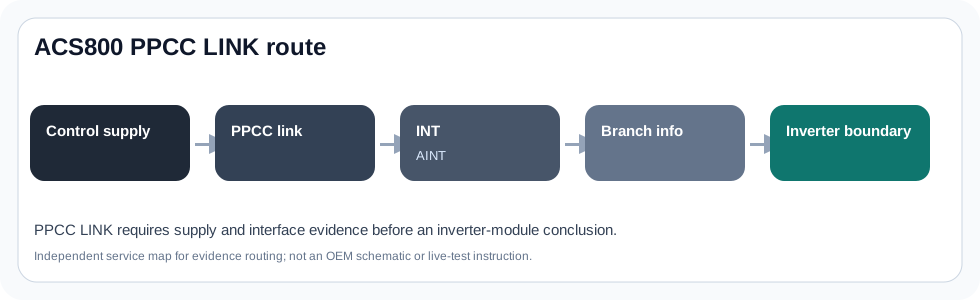
A PPCC path has three different service zones
The PPCC route begins at the control electronics, passes through a link medium and ends at inverter-interface electronics. In some arrangements it then continues through branch hardware to a particular inverter module. Each zone must be proven separately because the symptom at the panel can be the same when the failed zone is different.
Control-power evidence includes RMIO/RDCU supply, external 24 V wiring, panel state and any branch loads. Link evidence includes fibre or connector condition and routing. Interface evidence includes INT/AINT board identity, branch mapping and module relationship.
Interface path evidence
| Zone | Evidence | Repair boundary |
|---|---|---|
| Control side | RMIO/RDCU power, external 24 V, panel state | Control unit or supply route |
| Link medium | Fibre/connector condition, routing, strain | Cable/link service |
| Interface side | INT/AINT label, PBU branch, module suffix | Interface or branch route |
| Power stage | Only if output-stage evidence exists | AGDR/IGBT route, not PPCC alone |
What not to infer from the path
The PPCC path does not, by itself, prove a motor, cable or IGBT failure. It also does not prove that the first named board is bad. It proves that the communication/status route between control and inverter interface is not credible enough for operation.
The correct evidence package ties the fault to timing, control supply, link condition and physical branch identity. That package is what makes board repair or donor-board selection possible.
Field record checklist
- Control unit power
- External 24 V
- PPCC medium
- INT/AINT label
- PBU branch
- Module suffix
- Output-stage co-fault
Technical basis and reference documents
This is an independent editorial technical reference. Original manufacturer documentation remains controlling for installation, repair and commissioning decisions.
OEM basis for ACS800 fault messages, PPCC LINK context and interface-related status evidence.
OEM basis for cabinet-drive hardware safety, RMIO/control-board and module arrangement context.
Public field-service discussion showing why fibre-link condition and control-power readiness can matter in PPCC diagnosis.
Turn this record into a qualified service request
A repair decision is much more reliable when the request includes the exact identity of the drive, the first fault evidence and the machine condition when the symptom appeared.
- Complete drive type code / MLFB or nameplate model
- Fault code, fault value and first event before reset
- When the event appears: power-up, enable, ramp, run, decel or stop
- Motor/cable connected or isolated during the symptom
- Visible board, option-card, module and connector identifiers
- Previous repair history, replacement parts and repeat-failure pattern