
Scope of this technical record
Series record for A1000 fault isolation and board-level mapping based on official troubleshooting plus a reviewed 22 kW circuit set.
Qualified industrial-drive personnel only: isolate and verify DC-bus discharge before internal access; preserve fault trace before clearing trips.
A1000 fault-to-board route
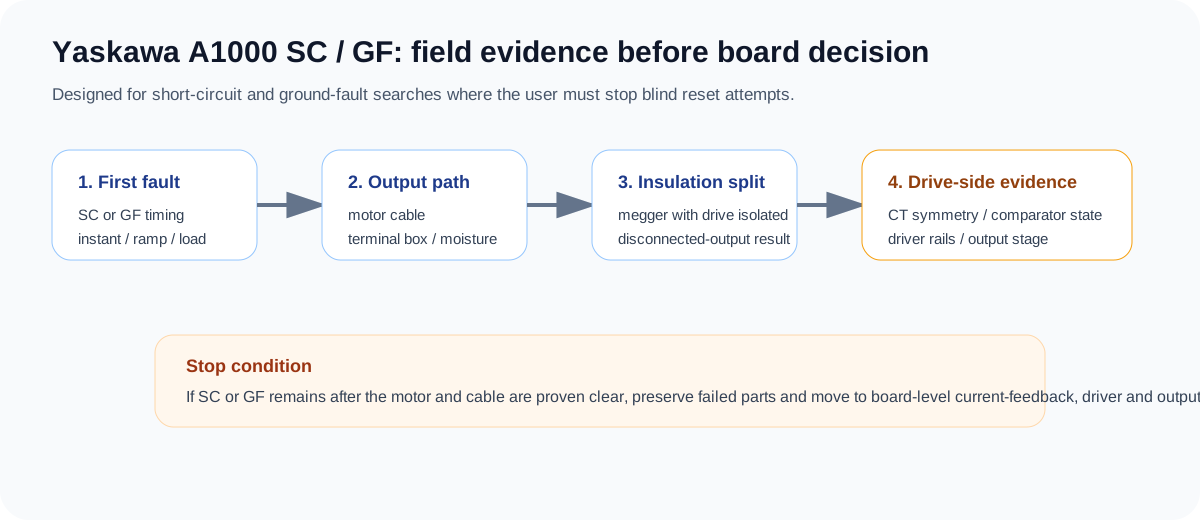
A1000 SC and GF service cases need an evidence split before a short-circuit or ground-fault label becomes a board decision.
A1000 SC / GF visual diagnostic split
Why A1000 belongs in a diagnostic database
Yaskawa A1000 is a high-performance vector-control drive family used in demanding motor-control applications. The official manual already offers substantial fault diagnosis and records fault trace/history through U2 and U3 monitor groups. That creates a strong starting point, but the technician who sees SC or GF still needs to decide whether evidence points to motor/cable failure, output semiconductor damage, gate supply or current-sensing/protection circuitry.
The reviewed A1000-22KW DB1–DB5 circuit set adds exactly that internal mapping layer. DB1 maps feedback-regulated auxiliary conversion, isolated rail groups and fan/relay support. DB3 maps voltage-monitoring and connector paths. DB4 exposes CT1–CT3 current channels, analogue supply rails and comparator/reference circuitry.
Fault entry routes
A1000 investigation entry
| Entry fault | Official first boundary | Drawing-informed internal boundary |
|---|---|---|
| SC | Output short-circuit / IGBT protection investigation | Gate supply and output-stage evidence after external isolation |
| GF | Output-side current-to-ground event | Output path and sensing/protection evidence if external insulation is clear |
| oC | Output current greater than overcurrent level | Load/output path before driver/feedback escalation |
| No-run after repair | Not a fault code alone | Supply, fan/relay, protection feedback and channel comparison |
How the circuit record changes diagnosis
When a technician arrives with SC, many public pages say to disconnect the motor and check the IGBT. That is necessary but incomplete after destructive failures. The five-sheet circuit map shows supply rails and current-feedback channels that can produce or contribute to protection behaviour. A collapsed rail, biased reference or damaged comparator path must be considered before a new power device is risked.
Equally, internal drawings do not justify ignoring official fault logic. GF still starts with safe external insulation separation; SC still demands power-stage caution; stored trace data must be captured before the technician erases the most useful evidence.
Support and repair decision
A useful A1000 inquiry provides full type code, power/voltage class, fault trace/history, whether motor/cable isolation changes the symptom, photographs of board/module labels and any prior semiconductor or board repairs. That information indicates whether the next action is field-side wiring correction, board-level evaluation, power-stage repair or replacement planning.
- Capture U2 fault trace and U3 history before reset
- Identify exact 22 kW board/drawing applicability or physical revision
- Separate external insulation failure from internal power stage
- Do not sacrifice another IGBT to an unverified driver/sensing path
From official protection event to board-level case
The A1000 technical manual provides the authoritative first layer: protection records and troubleshooting distinguish overcurrent and ground-fault conditions and preserve recent fault information. The owned 22 kW drawing record provides the second layer: a technician can map the supply, measurement and protection structures that matter once external wiring or motor causes are no longer adequate explanations.
This two-layer method is stronger than copying a fault table. It keeps the official code meaning intact while giving an industrial owner a route to a repairable board or module decision. It is especially relevant after an internal failure or an unsuccessful replacement, when a generic reset instruction is no longer responsible.
What will be expanded when demand appears
The first A1000 cluster is intentionally centred on SC/GF-style output protection and the reviewed 22 kW drawing set. Future content should be triggered by observed requests and cases, such as a consistent demand for undervoltage, fan/thermal problems or specific board identifiers. That approach increases the density of useful pages without diluting the database into a generic fault-code directory.
Technical basis and reference documents
This is an independent editorial technical reference. Original manufacturer documentation remains controlling for installation, repair and commissioning decisions.
Official fault, trace-data, maintenance and troubleshooting reference.
Circuit-function mapping of auxiliary supply, voltage/current sensing and interface paths; original drawings are not redistributed.
Model records
Fault records
Board and assembly records
Maps the isolated auxiliary supply channels that provide gate-driver rails, +24 V fan/relay support and monitored control-voltage signals in the reviewed A1000 22 kW record.
Maps CT1–CT3 input conditioning, reference circuitry and protection-feedback comparison around the output-current evidence path.
Circuit and diagnostic records
DB1-based circuit map for transformer-isolated secondary rails, regulated +24 V support and undervoltage/fan-relay logic used in the reviewed A1000 22 kW drawing family.
DB4-based map of CT1–CT3 signal conditioning, reference generation and comparator/transistor stages relevant when SC, GF or overcurrent evidence is inconsistent with external testing.
An A1000 reports SC or GF and the technician must separate motor/cable faults from internal drive damage.
A Yaskawa inverter has suffered output-module damage or repeat SC/GF-type trips after repair.
Turn this record into a qualified service request
A repair decision is much more reliable when the request includes the exact identity of the drive, the first fault evidence and the machine condition when the symptom appeared.
- Complete drive type code / MLFB or nameplate model
- Fault code, fault value and first event before reset
- When the event appears: power-up, enable, ramp, run, decel or stop
- Motor/cable connected or isolated during the symptom
- Visible board, option-card, module and connector identifiers
- Previous repair history, replacement parts and repeat-failure pattern