
Scope of this technical record
Model/circuit record for the A1000-22KW five-sheet drawing family.
The circuit maps are diagnostic references; confirm actual model and board revision before applying any replacement decision.
A1000 22 kW drawing evidence route
Use the reviewed drawing family as a functional map, not as a public schematic replacement or part-substitution approval.
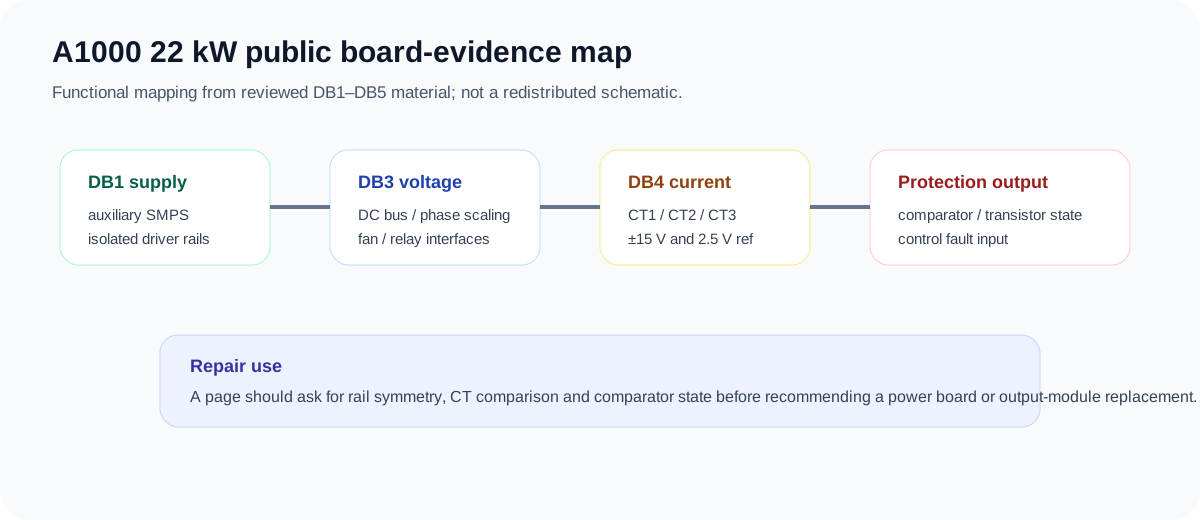
A1000 22 kW board evidence map
Five-sheet record and what it reveals
The reviewed sheets are labelled AB4A0044FAA (A1000-22KW) DB1 through DB5. DB1 depicts a regulated auxiliary converter with optical feedback, transformer-isolated rails and +24 V support for peripheral functions. DB3 adds scaled voltage-monitoring and fan/connector relationships. DB4 maps CT1, CT2 and CT3 through conditioning channels supplied by ±15 V and compared against a reference path.
This degree of internal evidence supports a real database page: it tells the technician whether a fault investigation concerns energy supply to driver sections, output feedback/protection logic or external power/load circuitry.
Drawing-to-page relationship
Reviewed sheet value
| Sheet evidence | Database interpretation | Common linked route | |
|---|---|---|---|
| DB1 | Auxiliary conversion, isolated rails, +24 V and undervoltage context | Supply/gate-support circuit | SC after module damage; no-run |
| DB3 | Voltage scaling, connectors and fan signalling | Voltage/interface context | Supply or protection state |
| DB4 | CT1–CT3, ±15 V, 2.5 V and comparator path | Current feedback/protection | GF/SC/overcurrent ambiguity |
| DB2/DB5 | Additional drive/interface relationships | Cross-check record | Revision-specific evaluation |
Practical restriction
A technician must not assume that a drawing labelled for 22 kW automatically matches every regional A1000 variant, revision or replacement board. Confirm nameplate, connector and board identifiers. The database records functional landmarks and connects them to a safe investigation sequence; it does not replace controlled board-level validation.
Why the record matters in service
A repair centre can act on a request that distinguishes a true shorted output stage from a suspected supply/feedback issue. Board photographs, fault trace, isolation result and observed supply/channel symmetry make a repair quotation more credible and reduce repeated destructive repair cycles.
Five-sheet functional map
The reviewed A1000-22KW drawing set separates useful functional regions. The first sheet shows a transformer/feedback-controlled multi-rail supply with isolated and control-voltage outputs. Other sheets expose scaled DC/phase measurements, fan and connector relationships, and CT/current-feedback conditioning with comparator/reference circuitry. These are the areas most relevant to protection trips that remain after external causes have been excluded.
The database does not treat the drawing package as a downloadable manual. It converts the evidence into relationships: which board zone supports gate operation, which supports measurement/protection, and which fault symptom creates a reason to examine that zone. This protects the value of the technical archive while producing usable public diagnostic content.
Use channel and reference comparisons before assigning a failed board
The examined A1000 22 kW drawings expose more than one functional area: isolated low-voltage supply generation, phase and DC-bus scaling networks, CT-based current feedback and comparator/reference sections. A protection trip can therefore be created by the output power stage, by a damaged gate supply, by feedback/protection circuitry or by an external motor/cable condition. It is not safe to jump from an SC or GF display directly to one board replacement.
For assessment, preserve board identifiers and connector orientation, compare equivalent phase paths, document supply/reference behaviour under isolated diagnostic conditions and keep the fault history before clearing it. These observations allow a repair centre to decide whether the likely work concerns the power module, driver/supply area, measurement/protection layer or the external circuit.
A1000 board-to-fault evidence map
| Observed clue | Candidate area | Why it matters |
|---|---|---|
| Short-circuit or ground-fault with external load excluded | Output module / driver / feedback protection | Internal failure becomes credible |
| Abnormal one-phase feedback compared with peers | CT/scaling/comparator branch | May create false or genuine protection response |
| Missing or unstable isolated driver rail | Multi-rail supply section | Gate switching cannot be judged safely |
| Burned driver components after module event | Coupled failure path | A replacement module can be destroyed again |
What constitutes repair-ready evidence
An A1000 board case is repair-ready only when the model and capacity are confirmed, the exact display and fault history are recorded, the motor and cable branch has been assessed by qualified personnel, and the visible board/module condition is documented. Without these items, a spare-board request can be the wrong service outcome.
IndustrialDriveData records this as a board-and-diagnostic relationship rather than offering a dangerous generic “replace the IGBT” instruction. The service value lies in narrowing the root-cause branch and helping an owner present a defensible repair or replacement inquiry.
Technical basis and reference documents
This is an independent editorial technical reference. Original manufacturer documentation remains controlling for installation, repair and commissioning decisions.
Official fault, trace-data, maintenance and troubleshooting reference.
Circuit-function mapping of auxiliary supply, voltage/current sensing and interface paths; original drawings are not redistributed.
Related technical records
The A1000 trips immediately or under output demand with an SC indication.
The A1000 indicates GF during operation or immediately after a run command.
DB1-based circuit map for transformer-isolated secondary rails, regulated +24 V support and undervoltage/fan-relay logic used in the reviewed A1000 22 kW drawing family.
DB4-based map of CT1–CT3 signal conditioning, reference generation and comparator/transistor stages relevant when SC, GF or overcurrent evidence is inconsistent with external testing.
An A1000 reports SC or GF and the technician must separate motor/cable faults from internal drive damage.
A Yaskawa inverter has suffered output-module damage or repeat SC/GF-type trips after repair.
Turn this record into a qualified service request
A repair decision is much more reliable when the request includes the exact identity of the drive, the first fault evidence and the machine condition when the symptom appeared.
- Complete drive type code / MLFB or nameplate model
- Fault code, fault value and first event before reset
- When the event appears: power-up, enable, ramp, run, decel or stop
- Motor/cable connected or isolated during the symptom
- Visible board, option-card, module and connector identifiers
- Previous repair history, replacement parts and repeat-failure pattern