
Scope of this technical record
Fault record for A1000 SC and the output-stage/driver boundary.
SC is a high-risk fault. Do not continue reset/start attempts while a short circuit or output semiconductor damage remains possible.
A1000 SC short-circuit route
A repeated SC with the output path proven clear moves the investigation toward current feedback, driver rails and output switching hardware.
SC route: output fault or drive-side evidence
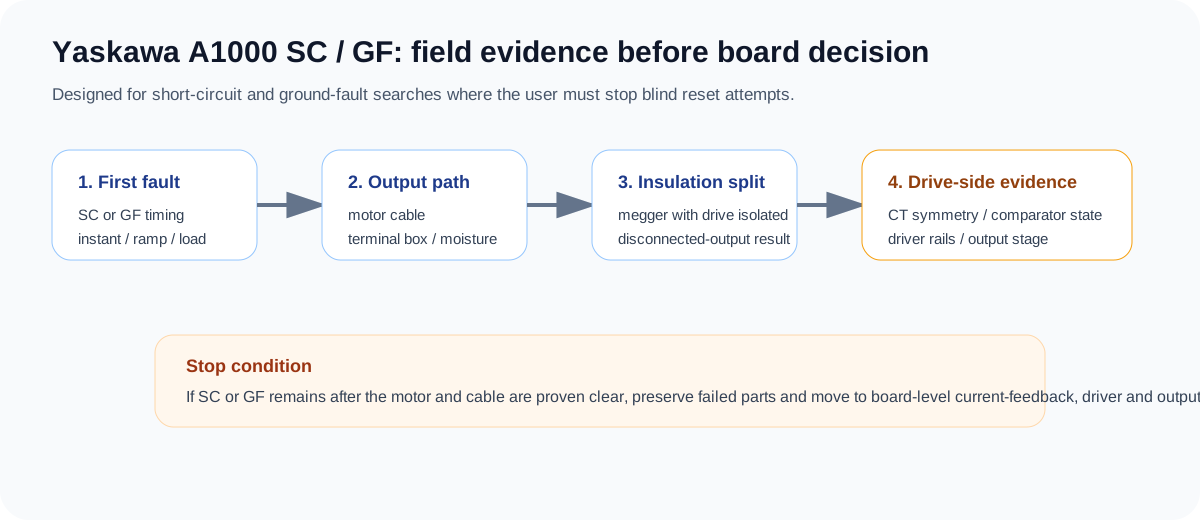
Service decision coverage
Most A1000 SC service cases are emergency repair cases. The page answers the field question before the parts question: is this still motor/cable evidence, or has it crossed into current-feedback and output-stage evidence?
| Observed field situation | Decision the technician needs | Evidence to collect |
|---|---|---|
| SC appears instantly at run | Do not keep resetting; split external output path from drive hardware | Motor disconnected result, static U/V/W check, fault trace timing |
| SC follows a module replacement | Assume an unresolved driver or feedback issue until proven otherwise | Driver rail symmetry, gate path comparison, prior failed parts |
| SC only under load | Treat load and acceleration demand before board replacement | Load coupling state, ramp settings, current trace |
Meaning and first evidence
An SC indication places the investigation at the output short-circuit and IGBT-protection boundary. The operator message is not sufficient to order parts: record stored trace information, the condition of the machine at fault, whether a previous module failure occurred and whether the motor/cable remains connected.
The initial external separation matters because output wiring or motor faults can cause the same protection response as internal semiconductor failure. Only after the external path is safely cleared does the drawing-based internal layer become justified.
Internal mapping after isolation
The reviewed A1000-22KW set identifies multiple isolated auxiliary rails and a current-feedback/protection path. If SC remains with the motor/cable excluded, an investigation should compare output-stage static evidence, driver-support rail symmetry and current-feedback/reference state. Damage in any of these relationships may make a replacement IGBT unsafe to energise.
SC evidence routing
| Evidence | Interpretation | Next step |
|---|---|---|
| Fault clears when motor/cable isolated | External short or insulation path likely | Repair external path and retest safely |
| SC persists without output load | Internal power/driver/protection issue likely | Bench-level evaluation |
| Prior IGBT exploded | Cascading driver/supply damage possible | Verify rails and channels before module |
| Sensing/reference asymmetry found | Protection evidence may be corrupted | Repair sensing/protection path |
What makes this better than a generic fault page
A generic page ends with “test motor and IGBT.” This record routes the fault through preserved trace data, external isolation, power-stage comparison, isolated supply evidence and CT/protection feedback before a replacement decision. This is the difference between a fault definition and a repair-qualified technical record.
Escalation boundary
Where safe comparative testing cannot be performed, the correct outcome is specialist evaluation rather than a speculative module purchase. Include full model, trace data, board/module labels, isolation outcome and photographs in any request.
SC must be treated as a protective shutdown, not a reset problem
A short-circuit type output trip indicates that releasing switching again without identifying the cause can be destructive. First preserve the fault record and the operating instant. Next separate external motor/cable causes under qualified procedures. A fault that remains with the external branch excluded increases the probability of an internal output-stage, driver-supply or feedback/protection failure.
The 22 kW circuit evidence supports an internal branch only after that isolation: the multi-rail driver supply must be credible, current/phase feedback routes must be considered and any visible output-stage damage must be linked to its driving/protection circuitry. This prevents an expensive module from being replaced into an unfixed drive.
Fault history first, power-stage suspicion second
On an industrial drive, the displayed protection code is a starting point rather than a component verdict. Capture the fault record and timing before repeated resets. Establish whether the event occurs during control power, immediately after run command, during acceleration, or after a disturbance. Then remove the external motor/cable branch from the decision only through appropriate qualified testing and manufacturer-safe procedures.
Where SC or GF persists after external causes are excluded, the reviewed drawing set supports a more disciplined internal branch: isolated driver-supply rails, CT/current-feedback conditioning, DC-bus or phase scaling, comparator protection and the output power stage. The correct question becomes which evidence separates these branches, not which expensive module should be changed first.
SC/GF decision log
| Stage | Record | Escalate when |
|---|---|---|
| Protection capture | Fault code, U2/U3 history, timing | Repeat or immediate trip is documented |
| External branch | Motor/cable/loading status | Trip persists after external cause is excluded |
| Internal inspection | Power-stage and board condition | Damage, contamination or asymmetry is visible |
| Controlled verification | Supply/reference/channel comparison | One internal path differs or supply cannot be trusted |
Do not bypass protection as a repair strategy
Any temporary diagnostic method that changes or suppresses a protective input carries a risk of destroying the drive or creating an unsafe motor condition. Such methods belong only in an appropriately protected specialist bench procedure with a documented purpose and a restoration check. They are not field reset instructions and should never be used merely to make a drive run.
Completion is not “fault no longer displayed.” Completion requires restored protection, stable supply and feedback evidence, an understood original cause, and an authorised functional test plan. That standard is particularly important for a high-value A1000 drive where repeat failure can multiply cost and downtime.
Technical basis and reference documents
This is an independent editorial technical reference. Original manufacturer documentation remains controlling for installation, repair and commissioning decisions.
Official fault, trace-data, maintenance and troubleshooting reference.
Circuit-function mapping of auxiliary supply, voltage/current sensing and interface paths; original drawings are not redistributed.
Diagnostic workflow
An A1000 reports SC or GF and the technician must separate motor/cable faults from internal drive damage.
A Yaskawa inverter has suffered output-module damage or repeat SC/GF-type trips after repair.
Turn this record into a qualified service request
A repair decision is much more reliable when the request includes the exact identity of the drive, the first fault evidence and the machine condition when the symptom appeared.
- Complete drive type code / MLFB or nameplate model
- Fault code, fault value and first event before reset
- When the event appears: power-up, enable, ramp, run, decel or stop
- Motor/cable connected or isolated during the symptom
- Visible board, option-card, module and connector identifiers
- Previous repair history, replacement parts and repeat-failure pattern