
Scope of this technical record
Fault record for GF and the boundary between external insulation and internal protection evidence.
Do not apply an insulation tester to drive electronics. Disconnect the motor/cable from the drive before qualified insulation testing.
A1000 GF ground-fault route
Treat GF as external until insulation evidence and disconnected-output behaviour justify an internal drive conclusion.
GF route: insulation before internal drive work
Service decision coverage
GF service cases need a conservative route because a wet motor cable, a contaminated terminal box and a biased current channel can all point at the same display code.
| Observed field situation | Decision the technician needs | Evidence to collect |
|---|---|---|
| GF after humidity or washdown | Field insulation is still the first suspect | Megger result with drive isolated, cable route photos |
| GF with motor leads removed | Internal sensing or output-stage leakage becomes more plausible | Disconnected-output test result, CT comparison, board supply state |
| GF after power-module work | Check repair boundary before re-energising | Gate driver condition, feedback comparator state, previous failure photos |
Official protection context
The A1000 technical manual describes GF as a current-to-ground condition on the output side exceeding the protection threshold, and lists damaged motor cable or output grounding conditions among causes. The first technical discipline is therefore not internal board replacement; it is establishing whether the external motor and cable path has genuinely failed to earth.
Fault timing remains important. A GF event under a run command, after repairs or with the external output path already cleared raises a different internal investigation than a cable visibly damaged in the machine.
When board-level mapping becomes relevant
If external insulation evidence is acceptable and GF behaviour remains, the technician must consider the inverter output stage and its protection/sensing route. The reviewed DB4 sheet shows CT input conditioning, ±15 V analogue support, a 2.5 V reference and comparator/transistor paths. Such circuits can be assessed for symmetry or obvious damage by qualified repair specialists; the page does not claim that every GF originates there.
GF separation
| Finding | Correct interpretation |
|---|---|
| Motor/cable insulation failure found | External cause; correct before any drive run |
| Fault disappears after external isolation | Drive may be responding correctly to external defect |
| Fault remains with external path clear | Internal output/protection investigation justified |
| Prior destructive output event | Include driver/sensing propagation assessment |
Completion criteria
A valid return-to-service decision records the fault trace, insulation separation, relevant internal evidence and controlled verification. Merely resetting GF without identifying the ground path invites repeat downtime or destructive failure.
Distinguish an external earth fault from an internal protection case
The official manual describes a ground fault in terms of output-side current to ground exceeding a protection threshold and identifies damaged motor cable as a possible cause. This makes the external branch the first responsible investigation: motor, cable, junctions and contamination at the application side should be assessed before internal board work is considered.
When a GF-type event remains after the external circuit is responsibly excluded, the owned drawing set helps route the internal investigation toward output-module damage, current-feedback/scaling paths and the supply/protection circuits that make a drive capable of detecting and responding to a fault. It does not justify defeating protection or re-energising visible damage.
Fault history first, power-stage suspicion second
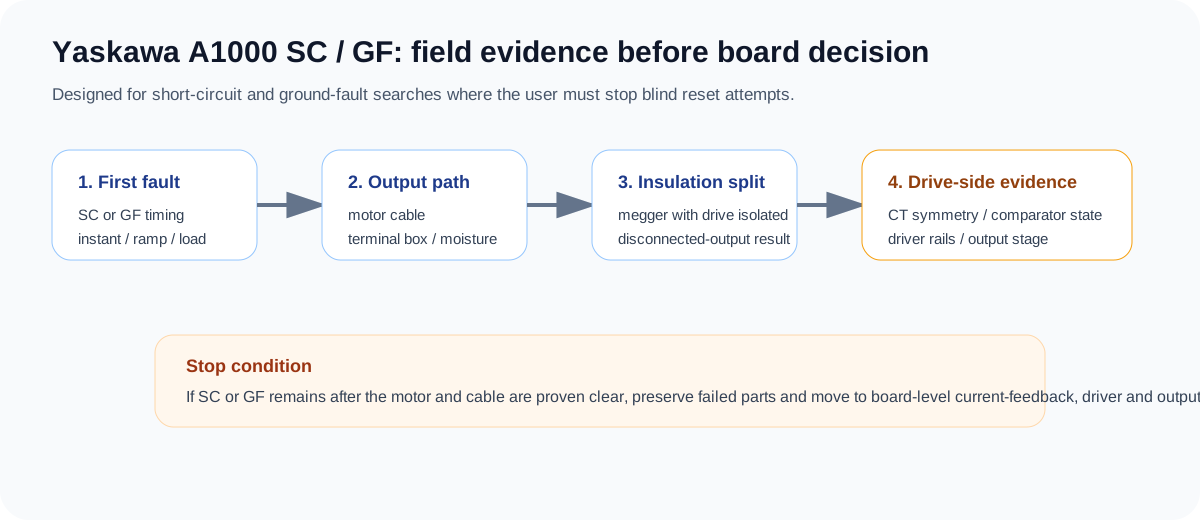
On an industrial drive, the displayed protection code is a starting point rather than a component verdict. Capture the fault record and timing before repeated resets. Establish whether the event occurs during control power, immediately after run command, during acceleration, or after a disturbance. Then remove the external motor/cable branch from the decision only through appropriate qualified testing and manufacturer-safe procedures.
Where SC or GF persists after external causes are excluded, the reviewed drawing set supports a more disciplined internal branch: isolated driver-supply rails, CT/current-feedback conditioning, DC-bus or phase scaling, comparator protection and the output power stage. The correct question becomes which evidence separates these branches, not which expensive module should be changed first.
SC/GF decision log
| Stage | Record | Escalate when |
|---|---|---|
| Protection capture | Fault code, U2/U3 history, timing | Repeat or immediate trip is documented |
| External branch | Motor/cable/loading status | Trip persists after external cause is excluded |
| Internal inspection | Power-stage and board condition | Damage, contamination or asymmetry is visible |
| Controlled verification | Supply/reference/channel comparison | One internal path differs or supply cannot be trusted |
Do not bypass protection as a repair strategy
Any temporary diagnostic method that changes or suppresses a protective input carries a risk of destroying the drive or creating an unsafe motor condition. Such methods belong only in an appropriately protected specialist bench procedure with a documented purpose and a restoration check. They are not field reset instructions and should never be used merely to make a drive run.
Completion is not “fault no longer displayed.” Completion requires restored protection, stable supply and feedback evidence, an understood original cause, and an authorised functional test plan. That standard is particularly important for a high-value A1000 drive where repeat failure can multiply cost and downtime.
Technical basis and reference documents
This is an independent editorial technical reference. Original manufacturer documentation remains controlling for installation, repair and commissioning decisions.
Official fault, trace-data, maintenance and troubleshooting reference.
Circuit-function mapping of auxiliary supply, voltage/current sensing and interface paths; original drawings are not redistributed.
Diagnostic workflow
Turn this record into a qualified service request
A repair decision is much more reliable when the request includes the exact identity of the drive, the first fault evidence and the machine condition when the symptom appeared.
- Complete drive type code / MLFB or nameplate model
- Fault code, fault value and first event before reset
- When the event appears: power-up, enable, ramp, run, decel or stop
- Motor/cable connected or isolated during the symptom
- Visible board, option-card, module and connector identifiers
- Previous repair history, replacement parts and repeat-failure pattern