
Scope of this technical record
Use this DCS800 hub when a DC drive service case needs to be routed between F521 FieldAck, field-exciter status, field supply, DCSLink communication, SDCS-CON-4 control electronics, SDCS-POW-4 auxiliary supply and SDCS-PIN-51 measurement/interface evidence.
DCS800 service involves armature power, field power, stored energy and control electronics. Qualified DC-drive personnel must isolate supplies, verify discharge and document board and field-exciter positions before internal work.
DCS800 FieldAck board-chain route
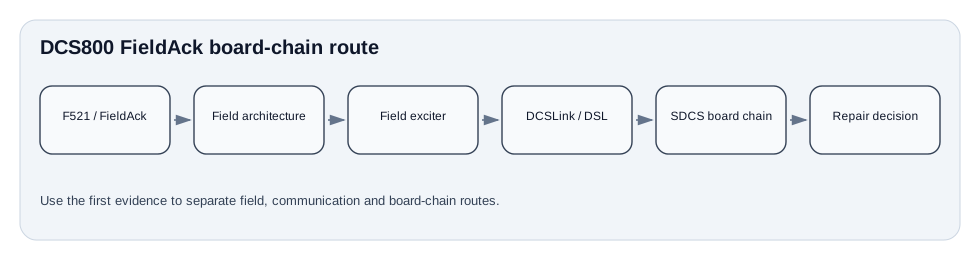
Start DCS800 cases from the field and board architecture
A DCS800 case is different from a standard AC drive case because the armature converter, field-exciter arrangement and SDCS board chain interact. F521 FieldAck can be caused by field wiring, field power, field-exciter readiness, communication with an external exciter, selected motor configuration or control-board interpretation.
A good service route therefore begins with architecture: D1-D4 or D5-D7 converter, internal or external field exciter, selected motor, board labels and whether the control electronics are stable. Without those facts, a board replacement can miss a field-circuit problem or a supply problem can be mistaken for SDCS-CON-4 failure.
DCS800 first-route selector
| Observed case | First route | Do not do first |
|---|---|---|
| F521 FieldAck | Selected motor, field supply, exciter status, acknowledge path | Replace SDCS-CON-4 before field proof |
| Dead or resetting electronics | Auxiliary supply, SDCS-POW-4, SDCS-CON-4 supply state | Focus only on the displayed field fault |
| External field unit present | DCSLink / DSL cable, termination, field-unit ready state | Treat the armature converter as the only fault location |
| D5-D7 board replacement request | Type code, frame, CON/POW/PIN labels, connector photos | Buy a donor board by series name alone |
F521 should remain on the field chain until proven otherwise
The useful question is not whether the drive says FieldAck. The useful question is why the selected motor field is not acknowledged. The field route includes the selected motor setup, field supply source, field fuse or protection, F+ / F- field wiring, the field exciter and the acknowledgement returned to the main converter.
If an external DCF field unit is used, communication evidence becomes part of the field route. Cable routing, termination, field-unit readiness and ready-lost history are as important as the main-converter fault text.
The SDCS board chain needs supply and interface evidence
When the control electronics are unstable, DCS800 service moves from the field route into a board-chain route. The D5-D7 evidence path begins at auxiliary input and SDCS-POW-4, then continues to SDCS-CON-4 and SDCS-PIN-51 measurement/interface evidence.
A repair request should include the converter type code, frame size, board labels, connector photos, field-exciter arrangement, fault timing and prior replacement history. That package is what separates board repair from donor-board sourcing or modernization.
Field record checklist
- DCS800 type code
- D frame size
- Selected motor
- FEX / DCF field architecture
- F521 timing
- Field supply evidence
- DCSLink / DSL status
- SDCS-CON-4 label
- SDCS-POW-4 label
- SDCS-PIN-51 label
Technical basis and reference documents
This is an independent editorial technical reference. Original manufacturer documentation remains controlling for installation, repair and commissioning decisions.
OEM basis for DCS800 safety, FieldAck / field-related fault context and DCS800 firmware diagnostic boundaries.
OEM basis for SDCS-CON-4, SDCS-POW-4, SDCS-PIN board-chain and D1-D7 converter hardware context.
OEM service context for SDCS-CON-4, board replacement and service procedures.
Public documentation context for DCSLink use with field exciters and communication-related service evidence.
Model records
DCS800 D1-D7 modules require service routing by converter size and board chain. D1-D4 and D5-D7 do not use the same power-interface arrangement, and F521 FieldAck cannot be judged without knowing the field exciter and board architecture.
DCS800 converter modules span D1 through D7 frames and use different power-interface arrangements while retaining a diagnostic relationship between control electronics, auxiliary supply, measurement/firing interfaces and the field system.
Fault records
The DCS800 reports F521, cannot confirm the selected motor field, or refuses to return to service because the field acknowledgement chain is not credible.
The DCS800 reports F521 and cannot establish a valid field acknowledgement for the selected motor.
Board and assembly records
Controls the DCS800 converter, interprets field acknowledgement, interfaces to power/interface boards and stores service-relevant configuration. It should be judged after supply, measurement/interface and field-chain evidence have been collected.
Feeds the control electronics board chain in applicable D5-D7 converters. It belongs at the start of dead-control, resetting-control or unreliable-board-chain investigations.
Connects D5-D7 power-section measurement and interface evidence to SDCS-CON-4. It is relevant when current, voltage, temperature, measurement or firing-interface evidence is part of the case.
Captures the field-exciter and field-circuit evidence needed to decide whether F521 belongs to field wiring, field supply, field exciter, DCSLink communication, configuration or main-control interpretation.
Collects board labels, converter identity, supply state, connector evidence, field-chain context and prior repair history before SDCS-CON-4, POW-4 or PIN-51 repair or donor-board decisions.
Stores firmware and parameters, performs drive control and watchdog supervision, monitors powerfail status and interfaces to measurement, I/O, communications and firing paths.
Generates the DC supply rails required by SDCS-CON-4 and associated electronic boards in D5–D7 converter modules from the auxiliary input supply.
Interfaces current, voltage and temperature measurement between the D5–D7 power section and SDCS-CON-4 while relating to the firing-board assembly.
Provides controlled field excitation and acknowledgement for the selected DC motor field arrangement.
Circuit and diagnostic records
Routes D5-D7 electronics evidence from auxiliary input through SDCS-POW-4, SDCS-CON-4, SDCS-PIN-51 and the measurement/firing interface before a control-board or measurement-board decision is made.
Maps F521 FieldAck from the selected motor and field circuit through internal FEX or external DCF field exciter evidence, communication and control acknowledgement.
Shows how the DCS800 D5-D7 board chain should be documented before classifying a case as control-board, power-supply-board, measurement-interface or downstream firing evidence.
Routes external field-exciter cases through DCSLink / DSL communication, termination, field-unit readiness and selected motor relationship before control-board decisions.
Connects field supply, field protection, motor field winding and field-current acknowledgement evidence for F521 service cases.
DCS800 D5–D7 modules depend on an explicit chain from auxiliary input through SDCS-POW-4 to the SDCS-CON-4 control board and onward through measurement and firing interfaces to the thyristor power section.
The DCS800 armature converter depends on the selected field excitation arrangement and its acknowledgement. The path may use an internal FEX-425 unit or external DCF803 / DCF804 equipment connected through the drive-to-field communication chain.
DCS800 displays F521 / FieldAck or cannot confirm the field acknowledgement for the selected DC motor.
DCS800 D5-D7 converter has dead control electronics, reset behavior, unstable status display, unreliable FieldAck context or suspected SDCS board-chain failure.
A service request asks whether SDCS-CON-4, SDCS-POW-4 or SDCS-PIN-51 should be repaired, replaced, sourced from a donor converter or used as part of a modernization decision.
F521, field ready lost, field-exciter communication context or a missing acknowledgement appears on a DCS800 installation with an internal or external field-exciter route.
A DCS800 DC drive displays F521 because field acknowledgement for the selected motor is missing.
A DCS800 D5–D7 converter shows dead or unstable control electronics, unexplained reset behavior or suspected board-chain failure.
Turn this record into a qualified service request
A repair decision is much more reliable when the request includes the exact identity of the drive, the first fault evidence and the machine condition when the symptom appeared.
- Complete drive type code / MLFB or nameplate model
- Fault code, fault value and first event before reset
- When the event appears: power-up, enable, ramp, run, decel or stop
- Motor/cable connected or isolated during the symptom
- Visible board, option-card, module and connector identifiers
- Previous repair history, replacement parts and repeat-failure pattern