
Scope of this technical record
DCS800 page depth for DCS800 D1-D7 module identification, focused on field acknowledgement, electronics supply and SDCS board evidence.
This record is for qualified industrial-drive personnel. Isolate the drive, verify stored DC energy is discharged and follow the manufacturer manual before measuring inside the converter or touching motor, brake, field or control wiring.
DCS800 module evidence route
The physical size and board arrangement decide the correct DC-drive path.
ABB dcs800 d1 d7 evidence image
What this DCS800 page must decide
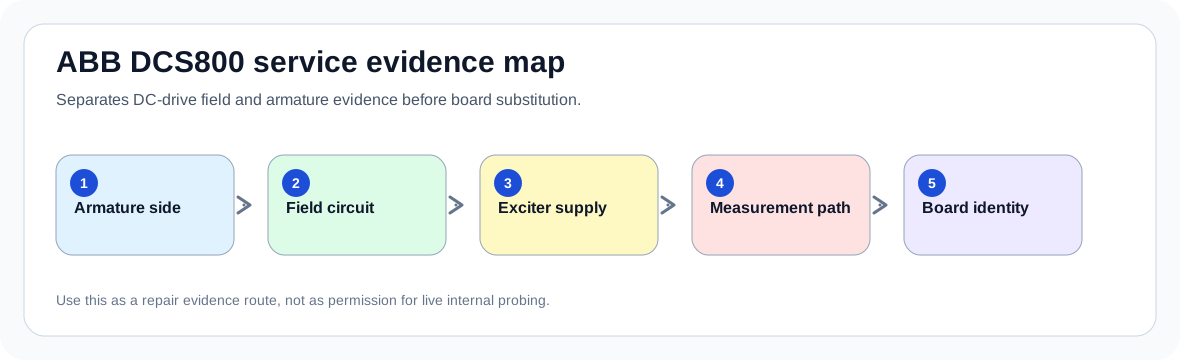
This page deepens the DCS800 route for DCS800 D1-D7 module identification. A DC drive case is not solved by treating every event as a control-board issue; the armature converter, field circuit, field exciter, auxiliary electronics supply and measurement/firing interfaces must be separated.
The page uses F521 FieldAck and electronics-supply evidence as the main pattern because those cases expose the difference between external field equipment, FEX/DCF exciter status, SDCS-CON-4 control logic, SDCS-POW-4 rails and SDCS-PIN-51 measurement paths.
DCS800 evidence boundaries
The first useful question is whether the converter reached the part of the sequence where field acknowledge, fan acknowledge or contactor acknowledge was expected. FieldAck evidence must include the selected motor, field exciter status and field circuit condition before a board is blamed.
For larger D5-D7 electronics-supply cases, supply loss, rail collapse and board loading can look like control-board failure. The route follows auxiliary input, SDCS-POW-4, X37 rails, SDCS-CON-4 and SDCS-PIN-51 before replacement is considered.
DCS800 service split
| Area | Why it matters | Evidence to collect |
|---|---|---|
| Field circuit | F521 may be caused by missing field acknowledge or exciter fault | Field fuses, contactor, winding, exciter display/LEDs |
| FEX-425 / DCF803 / DCF804 | Exciter type and node/status must match configuration | M1UsedFexType, Mot1FexStatus, node settings, exciter fault message |
| SDCS-POW-4 | Weak electronics supply can imitate logic-board failure | Aux input, X37 rails, 5 V CPU supply, Powerfail signal |
| SDCS-PIN-51 | Measurement interface affects current/voltage/temperature feedback | Board label, measurement symptoms, firing-interface condition |
Service route
Use this page to identify size family and board arrangement before comparing SDCS-CON, SDCS-POW and SDCS-PIN evidence.
The page is intentionally conservative. It asks for complete field and electronics evidence before recommending a control board, power supply board, field exciter or retrofit path.
Field record checklist
- Complete DCS800 type code and D1-D7 size
- Field exciter type and visible status/fault display
- F521 or electronics-supply event timing
- SDCS-CON/POW/PIN board labels where safe
- Armature/field contactor, fuse and motor field evidence
Technical basis and reference documents
This is an independent editorial technical reference. Original manufacturer documentation remains controlling for installation, repair and commissioning decisions.
Official source for DCS800 safety instructions, D1-D7 scope, FieldAck F521 logic and field-exciter status routing.
Editorial record format for SDCS-CON-4, SDCS-POW-4, SDCS-PIN-51, FEX/DCF field exciter and armature/field measurement evidence.
Related technical records
The DCS800 reports F521, cannot confirm the selected motor field, or refuses to return to service because the field acknowledgement chain is not credible.
The DCS800 reports F521 and cannot establish a valid field acknowledgement for the selected motor.
Shows how the DCS800 D5-D7 board chain should be documented before classifying a case as control-board, power-supply-board, measurement-interface or downstream firing evidence.
Routes external field-exciter cases through DCSLink / DSL communication, termination, field-unit readiness and selected motor relationship before control-board decisions.
Connects field supply, field protection, motor field winding and field-current acknowledgement evidence for F521 service cases.
DCS800 displays F521 / FieldAck or cannot confirm the field acknowledgement for the selected DC motor.
A service request asks whether SDCS-CON-4, SDCS-POW-4 or SDCS-PIN-51 should be repaired, replaced, sourced from a donor converter or used as part of a modernization decision.
F521, field ready lost, field-exciter communication context or a missing acknowledgement appears on a DCS800 installation with an internal or external field-exciter route.
A DCS800 DC drive displays F521 because field acknowledgement for the selected motor is missing.
Turn this record into a qualified service request
A repair decision is much more reliable when the request includes the exact identity of the drive, the first fault evidence and the machine condition when the symptom appeared.
- Complete drive type code / MLFB or nameplate model
- Fault code, fault value and first event before reset
- When the event appears: power-up, enable, ramp, run, decel or stop
- Motor/cable connected or isolated during the symptom
- Visible board, option-card, module and connector identifiers
- Previous repair history, replacement parts and repeat-failure pattern