
Scope of this technical record
Use this page when a DCS800 reports F521 / FieldAck and the case must be separated into selected motor setup, field supply, motor field wiring, internal or external field exciter, communication/acknowledge path, control interpretation or board-chain evidence.
Treat missing field acknowledgement as a stop condition. Do not test the armature path as a shortcut to field proof; isolate armature and field circuits before inspection.
DCS800 F521 FieldAck route
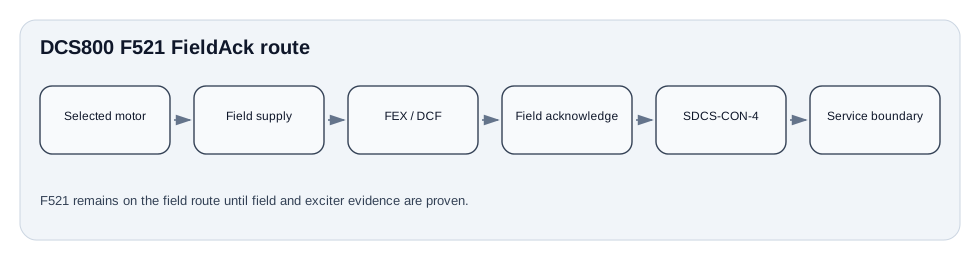
F521 is a field-chain evidence problem
F521 tells the service team that the selected motor field has not been acknowledged. It does not identify one board by itself. The same indication can originate at the field supply, field fuse, motor field circuit, internal field option, external field unit, DCSLink communication or control-board interpretation.
The first service record should preserve the selected motor, the exact field architecture, when the fault appears and whether the field unit has its own ready or fault evidence. That prevents a field-side problem from being converted into a control-board purchase.
F521 evidence split
| Evidence | What it separates | Next route |
|---|---|---|
| Internal FEX / external DCF identified | Field architecture | Field exciter link |
| Field supply and fuses documented | Power path versus electronics | Field supply acknowledge path |
| Field unit ready missing | Field-unit problem versus main converter | Exciter service route |
| Communication route unknown | DCSLink problem versus field hardware | DCSLink workflow |
| Control electronics unstable | F521 symptom versus board-chain problem | SDCS board-chain workflow |
Do not skip the motor field circuit
The motor field circuit is part of the drive evidence, not an external afterthought. Field terminals, fuses, field supply source and motor field wiring can stop acknowledgement before the SDCS control board has any fault of its own.
A field-unit replacement is not justified unless the field circuit and supply route have been separated from field-exciter readiness and communication evidence.
When the board chain becomes relevant
If the DCS800 has dead control electronics, repeated resets, unstable status indication or suspicious measurement/interface behavior, F521 should be reviewed together with the SDCS board chain. In D5-D7 hardware, that means auxiliary input, SDCS-POW-4, SDCS-CON-4 and SDCS-PIN-51 evidence.
The service decision should say whether the next action is field circuit repair, field exciter repair, DCSLink correction, configuration review, board-chain repair, donor converter review or modernization.
Field record checklist
- Selected motor
- Field architecture
- Field unit label
- Field fuse state
- F+ / F- wiring
- DCSLink / DSL evidence
- CON / POW / PIN labels
- Fault timing
Technical basis and reference documents
This is an independent editorial technical reference. Original manufacturer documentation remains controlling for installation, repair and commissioning decisions.
OEM basis for DCS800 safety, FieldAck / field-related fault context and DCS800 firmware diagnostic boundaries.
OEM basis for SDCS-CON-4, SDCS-POW-4, SDCS-PIN board-chain and D1-D7 converter hardware context.
OEM service context for SDCS-CON-4, board replacement and service procedures.
Public documentation context for DCSLink use with field exciters and communication-related service evidence.
Diagnostic workflow
DCS800 displays F521 / FieldAck or cannot confirm the field acknowledgement for the selected DC motor.
F521, field ready lost, field-exciter communication context or a missing acknowledgement appears on a DCS800 installation with an internal or external field-exciter route.
A service request asks whether SDCS-CON-4, SDCS-POW-4 or SDCS-PIN-51 should be repaired, replaced, sourced from a donor converter or used as part of a modernization decision.
Turn this record into a qualified service request
A repair decision is much more reliable when the request includes the exact identity of the drive, the first fault evidence and the machine condition when the symptom appeared.
- Complete drive type code / MLFB or nameplate model
- Fault code, fault value and first event before reset
- When the event appears: power-up, enable, ramp, run, decel or stop
- Motor/cable connected or isolated during the symptom
- Visible board, option-card, module and connector identifiers
- Previous repair history, replacement parts and repeat-failure pattern