
Scope of this technical record
Series entry for technicians identifying FR-A740 protection trips, power-driver board areas and repair versus parameter/braking decisions.
Only qualified personnel should work inside an inverter. Isolate supply, confirm DC bus discharge and observe Mitsubishi safety procedures before opening or testing hardware.
FR-A740 repair-intent route
FR-A740 cases become useful when the page separates acceleration, deceleration and thermal overload intent.
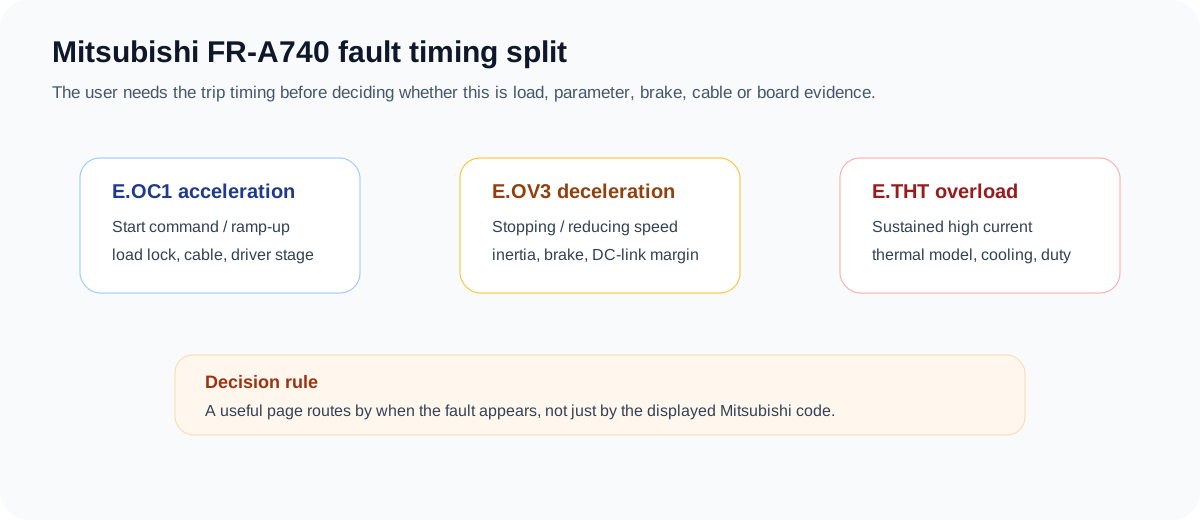
FR-A740 fault timing map
Why the FR-A740 becomes a high-value database track
The FR-A740 is not merely a catalogued inverter model. Mitsubishi positions the FR-A700 family for demanding torque and frequency-control applications including conveyors, winding and printing machinery. A production stop involving one of these machines creates repair intent that is more precise than a general VFD question: the operator wants to know whether the trip is load-related, parameter-related, braking-related, or a power/driver board failure.
The owned drawing family adds an important layer to the official manual. The manual explains protection logic and corrective actions; the reviewed 7.5 kW, 15 kW and 37 kW sheets make it possible to map auxiliary supply rails, isolated gate-drive channels, fan/thermal interfaces and connector relationships into an actionable investigation tree.
Model-family and circuit evidence
Official family material places the FR-A740 in the three-phase 400 V class. The reviewed records cover 7.5 kW, 15 kW and 37 kW variants, which are not automatically interchangeable but provide comparable circuit landmarks for repair triage. In the 37 kW sheet set, the auxiliary converter includes rectification/filtering, a feedback-controlled transformer supply and multiple service/driver rails; the driver sheet shows six isolated command channels and linked fan/temperature interfaces.
Evidence map
| Evidence layer | What it establishes | How it is used |
|---|---|---|
| Official manual | Ratings, terminals and named protection events such as E.OC1, E.OV3 and E.THT | Interpret the operator fault before opening hardware |
| Matched circuit sheets | Power supply, isolated gate-drive and connector path by examined rating | Identify the internal hardware boundary |
| Diagnostic workflow | Order of isolation, comparison and stop conditions | Prevent unnecessary board/module replacement |
Three entry faults worth prioritising
E.OC1 is valuable because it occurs during acceleration and official troubleshooting already requires separation of sudden acceleration, output short circuit and load/parameter causes. An immediate trip after repair changes the question: it may indicate unresolved output-stage or driver damage. E.OV3 is valuable because it separates regenerative DC-link energy during stopping from driver-board failure. E.THT matters because a sustained-load thermal model event is not the same as an instantaneous IGBT short.
Together these faults form a practical triage set: start-up overcurrent, stopping-energy overvoltage and time-dependent output-transistor overload. They lead to different pages and different service outcomes: field correction, braking-system evaluation or board/power-stage repair assessment.
Repair evidence before a quotation
A useful repair inquiry must include full FR-A740 model, rated capacity, fault code and when it occurs, load type, braking equipment, prior module changes and photographs of any identified board/module labels. A quote offered without this evidence can lead to an incompatible part or repeat destruction.
IndustrialDriveData therefore treats the FR-A740 series page as a routing page: official protection meaning leads to a workflow, the workflow leads to the relevant circuit/board evidence, and only then does replacement or workshop repair become a rational decision.
- Full model and capacity, including voltage class
- Displayed fault and operational timing
- Motor/load and brake-unit context
- Board/module photographs and replacement history
- Whether the motor/cable has been isolated and tested by qualified personnel
Where official fault logic stops and board diagnosis begins
Mitsubishi protection definitions are the first authority: E.OC1 indicates an overcurrent event during acceleration, E.OV3 identifies regenerative overvoltage during deceleration or stopping, and E.THT indicates a time-dependent inverter overload condition. Those meanings prevent the common mistake of treating every protection trip as a failed power board.
The board record becomes relevant only when field-side causes, operating conditions and parameters cannot explain the event, or when there is a history of power-module replacement, flash damage, unstable supplies or repeat trips immediately after an attempted repair. This is the exact gap addressed by the FR-A740 technical cluster: protection meaning is connected to a responsible evidence path.
Expansion plan within the database
The first public FR-A740 cluster intentionally focuses on three examined power ranges and three high-value protection routes. Later expansion should be driven by real field inquiries or workshop inquiries: for example, a concentration of E.OC1 requests at a specific capacity may justify a dedicated model and board-compatibility record, while repeated E.OV3 inquiries may justify braking-unit and DC-reactor content.
This structure protects quality. It avoids filling the database with generic parameter lists while allowing each new fault, board revision or repair case to connect to a validated series architecture.
Field record checklist
- Capture model and fault code
- Confirm operational timing
- Do not replace a power module before driver/supply review
Technical basis and reference documents
This is an independent editorial technical reference. Original manufacturer documentation remains controlling for installation, repair and commissioning decisions.
Official FR-A700/FR-A740 operating, parameter and protective-function reference.
Circuit-function mapping prepared from reviewed drawing records; original schematic files are not redistributed.
Model records
Fault records
The FR-A740 trips as the motor begins to accelerate or immediately after a start command.
The FR-A740 trips while stopping a rotating load or reducing speed.
The drive stops after sustained high current without an instantaneous overcurrent trip.
Board and assembly records
Organizes the auxiliary power conversion and multi-rail outputs that support the FR-A740 gate-driver and monitoring paths.
Connects six isolated drive channels and gate-return paths to the inverter output stage and associated fan/thermal feedback evidence.
Circuit and diagnostic records
A circuit-derived map of the FR-A740-37KW DB1 supply sheet: rectified input, flyback conversion, feedback regulation, ±15 V / +24 V services and isolated driver rails.
Maps the matched isolated drive stages, gate resistors/clamp paths and feedback connections visible across reviewed 7.5, 15 and 37 kW sheets.
Connects official E.OV3 logic with the FR-A740 braking and DC-link decision path used when an inertial load regenerates into the drive during stopping.
The FR-A740 reports E.OC1 during acceleration, immediately on start or after an output-stage repair.
The drive runs but trips with E.OV3 while decelerating or stopping an inertial load.
An FR-A740 output module has failed or been replaced, and the technician must decide whether the drive can be energised safely.
Turn this record into a qualified service request
A repair decision is much more reliable when the request includes the exact identity of the drive, the first fault evidence and the machine condition when the symptom appeared.
- Complete drive type code / MLFB or nameplate model
- Fault code, fault value and first event before reset
- When the event appears: power-up, enable, ramp, run, decel or stop
- Motor/cable connected or isolated during the symptom
- Visible board, option-card, module and connector identifiers
- Previous repair history, replacement parts and repeat-failure pattern