
Scope of this technical record
Fault-code interpretation and repair-routing record for E.OC1 during acceleration.
Do not reset and restart repeatedly into a possible short circuit. Ensure isolation and discharge before internal work; motor insulation tests must be performed with the motor/cable separated from inverter electronics.
FR-A740 E.OC1 startup route
E.OC1 is not automatically a bad inverter; the instant-trip case after isolation is what raises board-level suspicion.
E.OC1 acceleration decision image
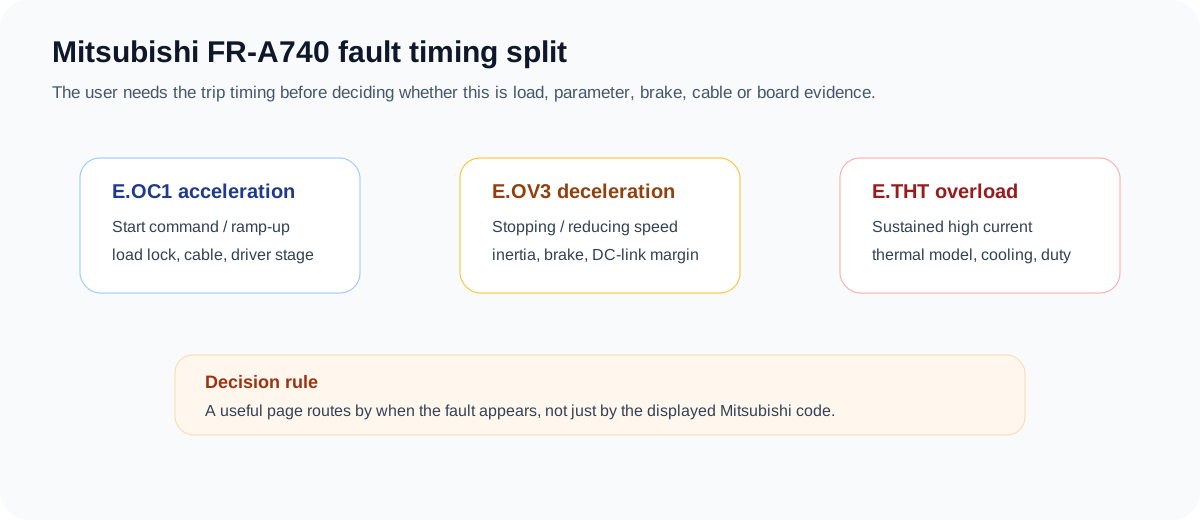
Service decision coverage
For E.OC1, the first service question is why the trip happens at start. The page separates acceleration demand and mechanical lock from output-stage and driver evidence.
| Observed field situation | Decision the technician needs | Evidence to collect |
|---|---|---|
| Trips before shaft movement | Stop repeated run attempts until output path is isolated | Motor cable insulation, static output bridge check |
| Trips during acceleration under load | Check ramp, torque boost and mechanical load first | Load condition, acceleration time, motor data |
| Trips after module replacement | Driver comparison becomes mandatory | Six-channel driver symmetry, supply rails, failed module history |
Official meaning and why timing matters
Mitsubishi defines E.OC1 as an overcurrent trip during acceleration. In the FR-A700 manual, the protective circuit stops inverter output when output current reaches or exceeds approximately 220% of rated current during acceleration. Timing is therefore diagnostic evidence: an event at the first start impulse is different from an event only after a mechanically coupled load gains torque.
The manual points to sudden acceleration, output short circuit, base-frequency error, stall prevention/current-limit settings, regeneration effects and certain vector-control wiring conditions. A board-level record adds a second layer: if external causes are eliminated and the trip persists immediately, the output bridge and six-channel gate-drive/support path must be treated as suspect until proven otherwise.
Branch the investigation before replacing hardware
A motor or cable defect must be addressed before the drive is accused. The correct field branch begins with evidence capture and controlled isolation. A mechanic jam or aggressive acceleration ramp can create real current demand without hardware failure; a persistent instant trip with the output separated raises the probability of internal damage.
E.OC1 branch logic
| Observation | Primary branch | Do not do |
|---|---|---|
| Trips only with coupled heavy load | Load/ramp/parameter assessment | Order an IGBT module on fault code alone |
| Trips with motor connected; cable insulation suspect | Motor/cable isolation and test | Megger through connected drive |
| Trips instantly with external output isolated | Internal output-stage and driver assessment | Repeat start attempts |
| Occurred after previous IGBT replacement | Driver/supply propagation review | Assume new module is defective without evidence |
Internal evidence from the reviewed circuit family
The FR-A740 circuit record shows a multi-rail auxiliary supply and a six-channel isolated gate-drive relationship. After a destructive output event, a collapsed isolated rail, damaged optocoupler/driver channel, altered gate resistance or protection-interface defect can cause a fresh module to be driven incorrectly. Comparative measurement across corresponding U/V/W upper and lower channels matters more than an isolated check of the visibly damaged phase.
Repair-completion criteria
A repaired drive is not complete merely because E.OC1 clears once. The technician needs a defensible cause, restored protection, stable auxiliary/driver evidence, balanced output under a controlled test and confirmation that the motor/load does not recreate the fault. Where these criteria cannot be obtained safely in the field, route the unit to a qualified industrial drive repair bench.
Acceleration-time symptom matrix
E.OC1 has unusually high diagnostic value because the operating instant is known: the event occurs during acceleration. Record whether the motor begins to move, whether the event follows a recent parameter or motor change, whether a heavily inertial or jammed load is present, and whether the fault remains after the motor/cable branch is evaluated. A trip that only occurs under loaded acceleration and a trip that occurs instantly after a repaired output stage are not equivalent cases.
For a board-level assessment, an instantaneous repeat event after verified external isolation raises the relevance of the six-channel driver path, gate support rails and output module. A fault that disappears when the application is separated requires the opposite service decision: avoid unnecessary internal board replacement and pursue motor/cable/load causes first.
Practical branching record
A competent workflow records observations before making a replacement decision. First capture the displayed trip and operating instant. Next identify whether the fault can occur with the motor disconnected under manufacturer-approved conditions, whether deceleration/braking conditions are relevant, and whether prior module or board work was performed. Only after these branches are documented should the investigation move to board-level evidence.
The value of this sequence is that identical-looking trips can have entirely different root causes. An acceleration overcurrent may come from an output short or mechanical demand; a regenerative overvoltage may be caused by deceleration energy and braking configuration; a repeated immediate trip after output-stage repair may justify analysis of gate-drive or feedback circuitry.
Workflow result categories
| Finding | Interpretation | Next controlled action |
|---|---|---|
| Fault clears after external circuit is isolated | Investigate motor, cable or application side | Do not replace internal board on that evidence alone |
| Fault persists without external cause | Internal stage becomes credible | Preserve fault log and request board/module assessment |
| Fault depends on stopping profile | Regenerative energy path is relevant | Review deceleration/braking design before board work |
| Recent module replacement and repeat trip | Companion damage is possible | Verify driver/supply/protection before further power testing |
Stop conditions for a field technician
Stop further attempts when there is visible power-stage damage, a repeat protective trip with external causes excluded, unstable control supplies, evidence of carbonisation or flashover, or uncertainty about DC-bus discharge and safe isolation. Repeated reset-and-run attempts can convert a repairable board problem into a destroyed power module and collateral control-board damage.
A useful escalation request contains the exact model, trip history, whether the trip occurs before or after output command, motor/cable test status, brake-unit details where relevant, and clear photographs of affected board and module markings. This turns a vague fault inquiry into a diagnostic case that a specialist can evaluate.
Technical basis and reference documents
This is an independent editorial technical reference. Original manufacturer documentation remains controlling for installation, repair and commissioning decisions.
Official FR-A700/FR-A740 operating, parameter and protective-function reference.
Circuit-function mapping prepared from reviewed drawing records; original schematic files are not redistributed.
Diagnostic workflow
The FR-A740 reports E.OC1 during acceleration, immediately on start or after an output-stage repair.
An FR-A740 output module has failed or been replaced, and the technician must decide whether the drive can be energised safely.
Turn this record into a qualified service request
A repair decision is much more reliable when the request includes the exact identity of the drive, the first fault evidence and the machine condition when the symptom appeared.
- Complete drive type code / MLFB or nameplate model
- Fault code, fault value and first event before reset
- When the event appears: power-up, enable, ramp, run, decel or stop
- Motor/cable connected or isolated during the symptom
- Visible board, option-card, module and connector identifiers
- Previous repair history, replacement parts and repeat-failure pattern