
Scope of this technical record
Workflow for deciding whether armature-voltage feedback is acceptable, whether feedback should be upgraded, or whether the drive requires repair.
Do not validate armature-voltage feedback with an unloaded run when the production machine requires load regulation or field weakening.
590P armature-voltage feedback workflow route
The workflow decides whether armature-voltage feedback is adequate for the machine duty.
590P armature-voltage feedback workflow
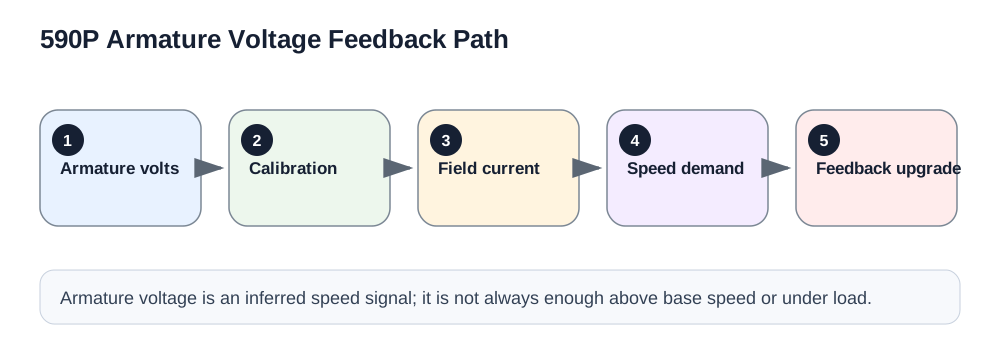
Suitability workflow
The workflow asks why armature-voltage feedback is being used, then tests whether the machine duty supports it. If the problem only appears under load or above base speed, a tachometer or encoder decision is often more relevant than a board repair.
This page is intentionally practical: it tells the technician what evidence to collect before deciding between parameter correction, feedback upgrade, donor drive or retrofit.
Armature-voltage feedback decision
| Question | Evidence | Output |
|---|---|---|
| Is armature volts intended? | Parameter and commissioning notes | Keep or change feedback mode |
| Is field weakening active? | Field current and top speed | Sensor feedback may be required |
| Does load disturb speed? | No-load versus load behaviour | Machine/load or feedback upgrade route |
| Is retrofit justified? | Duty, downtime, obsolete options | Repair or modernisation decision |
Field record checklist
- Do not assume default armature-voltage feedback is best for the application.
- Capture loaded behaviour and field state before tuning speed loop.
- Choose feedback upgrade or retrofit when application evidence demands it.
Technical basis and reference documents
This is an independent editorial technical reference. Original manufacturer documentation remains controlling for installation, repair and commissioning decisions.
Official source for 590+ safety, feedback selection and parameter context for speed feedback applications.
Official source noting that speed feedback can be armature voltage, analog tachometer, wire-ended encoder or Microtach feedback.
Explains speed-feedback alarm behaviour, armature-voltage feedback limitations and field-weakening effects.
Internal reviewed drawing references used only for functional path mapping; original drawings are not redistributed.
Linked records
A speed-feedback alarm is not a generic control-board fault. The useful split is whether the application is using armature-voltage feedback, analog tach feedback, wire-ended encoder feedback or Microtach feedback, then whether the problem is feedback polarity, scale, wiring, mechanical coupling, field weakening, armature-voltage calibration or the control-board input / option-card boundary.
Separates applications that can safely use armature-voltage feedback from machines that require tachometer or encoder feedback, especially where field weakening, load disturbance or precise speed regulation is involved.
Routes speed-feedback and encoder alarms through feedback-source selection, sensor power, wiring, polarity, scaling, mechanical coupling, field-weakening context and option-card or control-board input evidence.
Turn this record into a qualified service request
A repair decision is much more reliable when the request includes the exact identity of the drive, the first fault evidence and the machine condition when the symptom appeared.
- Complete drive type code / MLFB or nameplate model
- Fault code, fault value and first event before reset
- When the event appears: power-up, enable, ramp, run, decel or stop
- Motor/cable connected or isolated during the symptom
- Visible board, option-card, module and connector identifiers
- Previous repair history, replacement parts and repeat-failure pattern