
Scope of this technical record
Armature-voltage speed-feedback path for 590P / 591P drives, including when it is acceptable and when tachometer or encoder feedback becomes the better service answer.
Armature-voltage feedback is not proof of mechanical speed. Use it only within the machine limits and feedback assumptions defined by the application.
590P armature-voltage feedback path
The path explains when armature voltage is useful and when a tach or encoder is needed.
590P armature-voltage feedback path
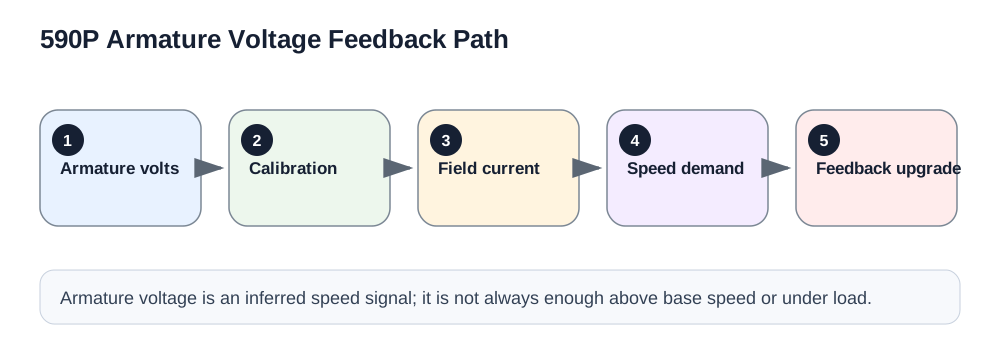
What armature-voltage feedback can and cannot prove
Armature-voltage feedback estimates speed from the motor armature voltage and related compensation. It avoids an external sensor, which is why it is common in simple commissioning and legacy installations. It is also why it can mislead troubleshooting on heavily loaded, low-speed or field-weakened machines.
When field weakening is active, the relationship between armature volts and actual mechanical speed is no longer the simple route many technicians assume. The page therefore treats armature-voltage feedback as a suitability decision, not just a parameter choice.
Evidence sequence
The path starts at armature voltage, then checks calibration and compensation, then field current, then speed demand and load behaviour. If those facts do not support stable regulation, the correct service result may be adding or restoring tachometer / encoder feedback instead of changing boards.
For retrofit planning, this path is especially useful: it separates drives that can remain in service with parameter correction from machines that should receive a feedback upgrade or a modern DC drive with a documented feedback option.
Field record checklist
- Record whether armature-voltage feedback is intentional or simply the default setting.
- Capture base speed, top speed and field-weakening requirement.
- Compare no-load and loaded behaviour before calling the drive faulty.
Technical basis and reference documents
This is an independent editorial technical reference. Original manufacturer documentation remains controlling for installation, repair and commissioning decisions.
Official source for 590+ safety, feedback selection and parameter context for speed feedback applications.
Official source noting that speed feedback can be armature voltage, analog tachometer, wire-ended encoder or Microtach feedback.
Explains speed-feedback alarm behaviour, armature-voltage feedback limitations and field-weakening effects.
Internal reviewed drawing references used only for functional path mapping; original drawings are not redistributed.
Turn this record into a qualified service request
A repair decision is much more reliable when the request includes the exact identity of the drive, the first fault evidence and the machine condition when the symptom appeared.
- Complete drive type code / MLFB or nameplate model
- Fault code, fault value and first event before reset
- When the event appears: power-up, enable, ramp, run, decel or stop
- Motor/cable connected or isolated during the symptom
- Visible board, option-card, module and connector identifiers
- Previous repair history, replacement parts and repeat-failure pattern