
Scope of this technical record
Evidence record for ATV61 / ATV71 voltage-fault repair requests, collecting the facts needed before classifying OSF or USF as a field supply issue, braking issue, precharge/DC-link issue or power-board repair case.
Collect photos and measurements only under site-approved safety procedure. Do not expose or handle charged DC-link, brake or input components. A USF indication is not proof that the DC bus is discharged.
Input / DC-link evidence record route
The record defines what makes a voltage-fault repair request actionable.
ATV61 / ATV71 input DC-link evidence image
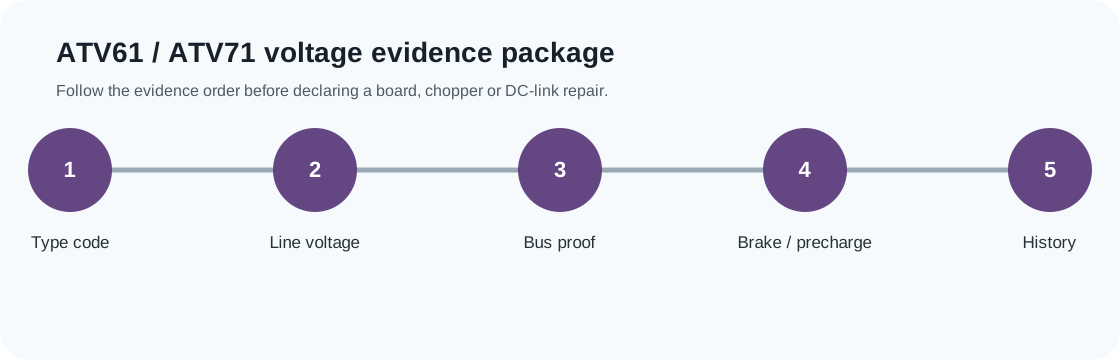
Voltage repair evidence matrix
The record makes an OSF/USF repair request auditable before a power board, precharge part or brake part is quoted.
| Evidence area | Decision | Required proof |
|---|---|---|
| Identity | Correct voltage/frame route | Type code, voltage class and application |
| Line / bus | Field versus internal fault | Drive-terminal voltage and DC-bus evidence |
| Brake / precharge | OSF or USF repair boundary | Resistor/chopper or precharge/DC-link proof |
Why voltage-fault evidence needs its own record
The evidence needed for OSF and USF is not the same as the evidence needed for OCF or SCF. Output faults need motor/cable proof. Voltage faults need line, charging, storage, braking and bus-feedback proof. Mixing these records leads to the wrong part request and poor repair outcomes.
Minimum evidence before a voltage-board decision
A service engineer should be able to see the drive identity, the first event, the line measurements, the DC-bus evidence and the braking or precharge route before deciding whether the case is field correction, bench repair or replacement planning.
- Full ATV61 / ATV71 type code and voltage class
- First fault order and event timing before reset
- L1/L2/L3 measurements at the drive terminals
- DC-bus measurement and PA/PC measurement method where qualified
- Fuse, contactor, line reactor and terminal photo evidence
- Brake resistor/chopper/resistor thermal evidence for OSF cases
- Precharge, rectifier, capacitor and power-board photo evidence for USF cases
Repair request triage
If line voltage is out of range at the drive terminals, the request belongs to field supply correction before drive repair. If OSF follows a high-inertia deceleration and the brake route is undocumented, the request belongs to energy-management evidence first. If USF remains with stable input and abnormal bus charge, the request can move to precharge/DC-link repair evidence.
Evidence record triage
| Evidence package result | Likely next action | Do not do yet |
|---|---|---|
| Input voltage wrong at drive | Correct supply path | Replace DC-link board |
| OSF only during decel | Prove ramp and brake route | Assume control-board failure |
| USF with stable line and abnormal charge | Prepare precharge/DC-link repair evidence | Repeated power cycling |
| Fault after prior repair | Reconcile repair history with measurement points | Install another board without root cause |
Field record checklist
- Type code and voltage class
- Fault timing before reset
- Line terminal measurements
- DC-bus evidence
- Brake or precharge evidence
- Previous repair history
Technical basis and reference documents
This is an independent editorial technical reference. Original manufacturer documentation remains controlling for installation, repair and commissioning decisions.
Used to anchor OSF around DC-bus over-supply detection during capacitor charging and PWM-deactivated states.
Used to anchor USF around low DC-bus voltage and field measurements on L1/L2/L3 and PA(+)/PC(-).
Used to anchor undervoltage thresholds, incoming line checks, monitoring menu comparison and undervoltage-management timing.
Used for family-level fault-management and drive-parameter context; public pages avoid reproducing proprietary tables.
Linked circuit records
Turn this record into a qualified service request
A repair decision is much more reliable when the request includes the exact identity of the drive, the first fault evidence and the machine condition when the symptom appeared.
- Complete drive type code / MLFB or nameplate model
- Fault code, fault value and first event before reset
- When the event appears: power-up, enable, ramp, run, decel or stop
- Motor/cable connected or isolated during the symptom
- Visible board, option-card, module and connector identifiers
- Previous repair history, replacement parts and repeat-failure pattern