
Scope of this technical record
Maps the Yaskawa 616G3-style discrete gate-drive and fast VCE protection behaviour into a public repair reference for OC/GF trips, weak gate drive and repeat module failure after board work.
The protection path must not be bypassed. Treat it as evidence about module stress or driver weakness, not as a nuisance signal to silence.
616G3 VCE fast-protection route
Fast module protection may be acting correctly; the repair question is why VCE rises during an on-command.
616G3 VCE fast-protection image
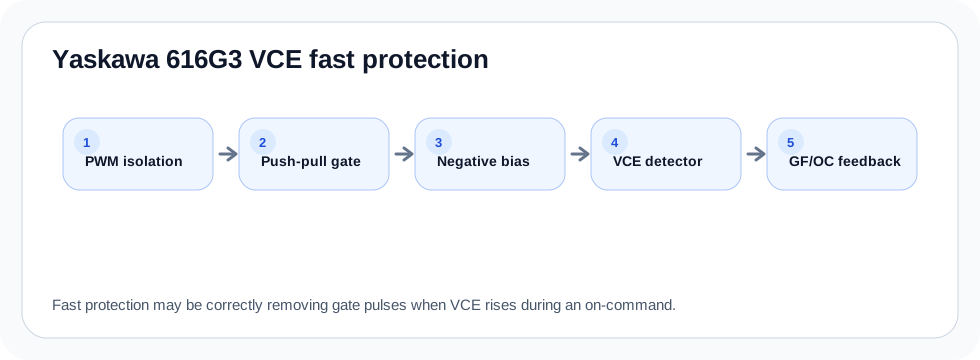
Service decision coverage
This is not a generic OC/GF page. It explains whether fast VCE protection is proving a true module stress or exposing weak gate-current drive.
| Observed field situation | Decision the technician needs | Evidence to collect |
|---|---|---|
| Instant OC/GF | External short or fast protection event | Output isolation, VCE detector state |
| PWM exists but module does not turn on hard | Driver current capability is suspect | Gate waveform, positive/negative bias comparison |
| Protection was bypassed or modified | Stop and restore protection logic | GF/OC feedback path and module condition |
Why this page is more useful than a fault-code definition
A fault-code definition only says short circuit, ground fault or overcurrent. The 616G3 driver/protection case explains why the driver may cut the pulse before slower current feedback has time to react. That timing is exactly what a repair technician needs to understand before changing a module.
The core question is whether the IGBT failed to conduct properly because the external load current was abnormal, the module itself was damaged, or the driver could not deliver enough gate current. A weak driver can make the collector-emitter voltage rise during a commanded-on pulse and trigger fast protection even when the original root cause is in the driver path.
Protection-path interpretation
The discrete circuit is useful because it exposes the physical evidence that integrated driver ICs often hide.
VCE protection map
| Circuit area | Repair meaning | Evidence to compare |
|---|---|---|
| PWM optocoupler | Command is isolated from logic side | Input/output pulse presence |
| Push-pull gate stage | Provides transient gate charge and discharge current | Positive pulse, sink ability, heating |
| Negative gate bias | Keeps IGBT safely off | Off-state gate voltage across phases |
| VCE detection | Detects high voltage drop during on-command | Threshold path and diode/transistor state |
| GF/OC feedback | Returns module-protection event to CPU | Feedback optocoupler state and event timing |
Field-to-bench handoff
The field record should state whether the event occurs with the motor disconnected, under load only, after a repair, or on one phase. The bench record should then compare all six channels for gate drive, negative bias and protection feedback.
A board that receives PWM but cannot source or sink gate current is not repaired because the logic pulse exists. The module is a capacitive gate load that demands current; the page makes that invisible requirement explicit.
Field record checklist
- Trip timing
- Output path condition
- Positive and negative gate bias comparison
- PWM-to-gate result
- VCE/protection feedback evidence
Technical basis and reference documents
This is an independent editorial technical reference. Original manufacturer documentation remains controlling for installation, repair and commissioning decisions.
Used to transform discrete driver and VCE protection explanation into a public functional map.
Used for general drive safety and fault-context alignment.
Diagnostic workflow
Turn this record into a qualified service request
A repair decision is much more reliable when the request includes the exact identity of the drive, the first fault evidence and the machine condition when the symptom appeared.
- Complete drive type code / MLFB or nameplate model
- Fault code, fault value and first event before reset
- When the event appears: power-up, enable, ramp, run, decel or stop
- Motor/cable connected or isolated during the symptom
- Visible board, option-card, module and connector identifiers
- Previous repair history, replacement parts and repeat-failure pattern