
Altivar AC drives / VFDs
Technical records for Schneider Electric / Telemecanique variable speed drives, beginning with ATV61 and ATV71 field-service fault routing, input/DC-link checks, motor-output short-circuit checks and control-terminal evidence capture.
Scope of this technical record
Schneider Electric Altivar coverage is focused on ATV61 / ATV71 service cases where short codes such as OCF, SCF, OSF and USF must be routed into load, motor cable, output bridge, DC-link, braking and terminal-command evidence.
Use only for qualified industrial-drive personnel. Altivar output, DC-link and line terminals remain hazardous after stop; isolate supply, secure driven machinery and verify discharge before output or internal work.
Schneider Altivar evidence route
Altivar OCF/SCF cases need setup, load and insulation evidence before power-board conclusions.
Schneider Altivar fault evidence map
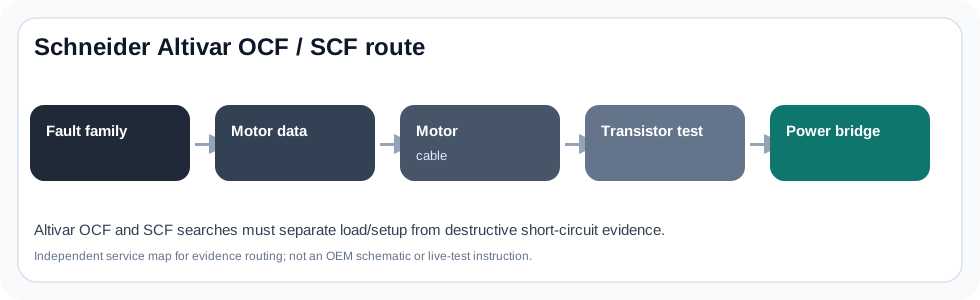
Schneider Altivar evidence required before reset
ATV61 and ATV71 users often case by short fault codes, especially OCF and SCF. The practical need is not another alphabetic code list. They need to know whether the trip belongs to mechanical load, ramp and motor data, motor cable insulation, output-to-ground leakage, power bridge condition or command-reference behaviour.
Schneider ATV71 application context includes hoisting, material handling, packaging, process control, wood machinery and high-inertia loads. That context matters: a high-inertia load or a brake timing problem can produce an overcurrent symptom without an internal board failure.
Schneider Altivar service map
| Request | First service boundary | Field evidence |
|---|---|---|
| ATV61 / ATV71 OCF | Load, ramp, motor data, motor cable, output current path | Trip timing, motor nameplate, acceleration ramp, brake/load condition |
| ATV61 / ATV71 SCF | Output short to ground or phase-to-phase; power bridge protection | Motor/cable isolation, terminal condition, whether trip persists with output isolated |
| ATV61 / ATV71 OSF | DC bus overvoltage, regeneration, deceleration, braking path | Line voltage, stop command, load inertia, brake resistor/chopper evidence |
| ATV61 / ATV71 USF | Input supply, fuses, contactor, precharge, DC link | Terminal voltage, upstream device state, bus build-up behaviour |
Brand-level repair discipline
For Schneider pages, the key editorial rule is to connect the code to the machine event. OCF during a heavy lift, SCF at enable after a washdown, OSF during a fast stop and USF after a contactor drop are not the same diagnostic problem. Each needs a different first measurement and a different stop condition.
The brand page should also help users avoid harmful resets. SCF and output short events are protective reactions to potentially destructive conditions. Repeating start commands before motor/cable isolation can convert a repairable external fault into a damaged power bridge.
Altivar evidence boundary
| Boundary | What to record | Why it prevents waste |
|---|---|---|
| Mechanical load | Brake release, jam, inertia, process event | Prevents replacing the drive for a stuck machine |
| Motor data and ramp | Rated current, voltage, speed, control mode, acceleration/deceleration | Prevents setup-caused current trips |
| Motor cable / insulation | Terminal box, cable route, leakage or phase-to-phase condition | Separates external short from bridge fault |
| Power bridge | Static output evidence after external route is proven | Avoids blind bridge replacement |
| DC link / brake | Bus trend, line voltage, brake resistor/chopper evidence | Separates regeneration from hardware failure |
Field record checklist
- Full ATV61/ATV71 type code and rating
- Displayed fault code and trip timing
- Application type: pump/fan, hoist, conveyor, high-inertia machine or process drive
- Motor data, acceleration/deceleration and control mode
- Motor/cable insulation and terminal evidence
- DC-link/braking and previous repair history where relevant
Technical basis and reference documents
This is an independent editorial technical reference. Original manufacturer documentation remains controlling for installation, repair and commissioning decisions.
Used for application context, protection families and service-routing orientation.
Public FAQ material for OCF/SCF first-pass causes and output short-circuit routing.
Available series
Schneider ATV61 / ATV71 service hub for routing OCF/SCF output faults, OSF/USF voltage faults and command/reference problems through motor, input, DC-link, braking, control-terminal and power-stage evidence.
ATV61 and ATV71 coverage is organized around two evidence clusters: output faults (OCF/SCF) and DC-link voltage faults (OSF/USF). The voltage cluster now separates high line or regenerated energy from low-line, contactor, precharge and DC-link evidence before a drive is replaced.
Turn this record into a qualified service request
A repair decision is much more reliable when the request includes the exact identity of the drive, the first fault evidence and the machine condition when the symptom appeared.
- Complete drive type code / MLFB or nameplate model
- Fault code, fault value and first event before reset
- When the event appears: power-up, enable, ramp, run, decel or stop
- Motor/cable connected or isolated during the symptom
- Visible board, option-card, module and connector identifiers
- Previous repair history, replacement parts and repeat-failure pattern